

069 results
What was built and checked for each unit of 069. Each unit keeps to its own section.
Unit 1a: BoxMenu
Built on 29 October 2026. A box’s menu is now one component, BoxMenu,
for a thread’s box and for a machine of your own. Nothing a person sees or
does changes.
What changed
BoxMenu, insrc/app/box-menu.tsx, holds the menu’s button, its items, when each is offered, and the dialogs its items open: New thread on this box…, Resize… and the Release confirmation.- It takes the box, whose it is, where its views open, and whether its Resize dialog is open. A thread’s box brings its thread, whether it is the thread’s own BB machine (held), whether New thread is offered, and the row’s way to Start, Stop, Release and Check now. A machine of your own brings whether Open in browser is offered and the row’s Start, Stop and Remove.
- The row keeps whether Resize is open, as its resize note hides while the dialog is open, as before.
BoxRow(the Box panel and the Boxes page’s Threads tab) andMachineRow(the Boxes page’s Machines tab) renderBoxMenuin place of their own menus. Their props are unchanged.BoxActionmoved tobox-menu.tsx.- What differed between the two menus still differs, as
BoxMenusays by whose box it is: a machine’s menu offers Open desktop only (never a device’s Simulator or Emulator), Open in browser only on the Boxes page, no Check now, and Remove…, which opens the Machines tab’s own dialog with its in-use guard.
Files: new src/app/box-menu.tsx; changed src/app/box-row.tsx and
src/app/settings-machines.tsx, which also loses imports nothing used and
isMoving, which nothing called. Shared files touched: src/app/desktop.tsx
and src/app/panel.tsx, one import line each, for BoxAction. No server
change. No test changed: the app tests already pin each menu item by item,
in each place:
- the panel lists the thread’s boxes as rows, opens a row’s details, and opens a desktop (a desktop box’s whole menu, and Open in browser);
- Resize is offered only where the box’s backend changes a part (061);
- releasing a box asks first;
- the panel stops and starts a box that can, and not one that cannot (a real box’s whole menu);
- a row starts a child thread on its box, and opens it; a box that is not a BB machine offers no thread;
- the Boxes page’s Threads tab (a thread box’s whole menu, with no New thread) and its Machines tab (Open in browser, Remove… and its dialog);
- the box this thread runs on, without Release or Stop (its whole menu);
- F-19: each screen in a tab of its own (Simulator before Desktop).
Checked
On a fresh Linux box, 8 cores, on the commits delivered, rebased onto main
66682093 (main’s next commit, e58e31a6, changes only
067-results.md):
| Check | Result |
|---|---|
tsc |
passes |
| Node suite | 2,841 tests: 2,553 pass, 0 fail, 288 skipped (the live suites, skipped as on main), 4 min 4 s |
| vitest | 306 pass, in 4 files |
test/docs.test.ts, test/site.test.ts and scripts/reference.ts --check |
pass; the reference is unchanged |
On the live check’s box, once that BB and its desktops ran there, one
server test, “High resolution doubles a Linux desktop’s pixels with Xfce at
2x…”, failed 3 times in 3 on main c108795e and on this branch alike; it
passed there before, and passes on the fresh box.
The live check below ran with the branch rebased onto c108795e; main’s
next commit, 66682093, changes none of this unit’s files.
Live check on a separate BB
A Linux box with Docker, 8 cores, 16 GiB, ran a fresh npx bb-app 0.48.0
with no account, its own data folder and ports, started with env -i,
HOME and PATH only. bb-box was installed with bb plugin install of a
path: first main c108795e (“before”), then this branch (“after”), over
the same data, so the same boxes. A Docker backend on the box’s own Docker
ran bb-box’s Linux and Linux desktop images, built with
setup/docker/build.sh. A project and a thread were made with bb project create and bb thread spawn; the thread’s agent has no login, so it
stopped at once, idle.
Boxes, made through bb-box’s CLI as a thread or a person would:
- for the thread: ready-heron (Linux) and bright-sparrow (Linux desktop);
- machines of your own: workbench (Linux) and studio (Linux desktop);
- for each run, two more boxes for the thread and one more machine, to be released and removed through the menu.
None joined BB as a machine: a BB with no account cannot (bb connect needs one), so each row says “Could not join BB”.
live-check.mjs drives headless
Chromium at 1440 by 1000. In each place it opens each box’s menu, records
its items, which are disabled and its separators, takes a screenshot, then
uses every item and checks what it did through the page, the clipboard,
new browser tabs, the RPCs the page sent, and bb-box’s own state. Both runs
passed, every item doing the same:
| Place | Box | Item | What it did, before and after alike |
|---|---|---|---|
| Box panel | ready-heron | Copy address | the clipboard held its address |
| Check now | sent refresh with the thread and the box |
||
| Resize… | opened “Resize ready-heron”, which asked resize with the thread |
||
| Stop, then Start | stopped, then ready, as bb-box’s state said | ||
| Open terminal | a panel tab “Terminal: ready-heron”, connected | ||
| bright-sparrow | Open in browser | a new browser tab at /plugins/bb-box/desktop/<thread>/<box> |
|
| Open desktop | a panel tab “Desktop”, streaming the box’s desktop | ||
| the first spare | Release… | asked “Release …? Its disk and everything on it will be deleted…”, then released it | |
| Boxes page, Threads | ready-heron | Copy address, Check now, Resize…, Stop, Start | as in the panel |
| Open terminal | the page went to <thread>/<box>/terminal |
||
| bright-sparrow | Open in browser | a new browser tab at the same address as the panel’s | |
| Open desktop | the page went to <thread>/<box> |
||
| the second spare | Release… | asked, then released it | |
| Boxes page, Machines | workbench | Copy address | the clipboard held its address |
| Resize… | opened “Resize workbench”, which asked machines.resize, with no thread |
||
| Stop, then Start | stopped, then ready | ||
| Open terminal | the page went to operator/<box>/terminal |
||
| studio | Open in browser | a new browser tab at /plugins/bb-box/desktop/operator/<box> |
|
| Open desktop | the page went to operator/<box> |
||
| the spare machine | Remove… | asked “Remove …? Its machine leaves BB…”, then removed it | |
| BB Box settings | no box menu on the page, before or after |
The 13 menus recorded, items in order, were the same in both runs, with the same disabled items (none) and the same 2 separators each, once each run’s spare boxes’ names were set aside:
| Place | Box and state | Items |
|---|---|---|
| Box panel and Threads | ready-heron, ready | Open terminal, Copy address, Stop, Resize…, Check now, Release… |
| ready-heron, stopped | Copy address, Start, Resize…, Check now, Release… | |
| bright-sparrow, ready | Open desktop, Open in browser, Open terminal, Copy address, Stop, Resize…, Check now, Release… | |
| Machines | workbench, ready | Open terminal, Copy address, Stop, Resize…, Remove… |
| workbench, stopped | Copy address, Start, Resize…, Remove… | |
| studio, ready | Open desktop, Open in browser, Open terminal, Copy address, Stop, Resize…, Remove… |
The runs’ records: before, after.
Screenshots, before and after
menus-at-sizes.mjs opened
each of the four boxes’ menus in each place at 1440, 760 and 390 px, dark
and light: 36 screenshots a run, with no spare boxes listed.
compare.mjs compared them pixel by
pixel. 25 of 36 are identical. In the other 11, 2 to 23 pixels differ, each
by 1 to 3 levels of 255, all on the anti-aliased rounded corners of the
search field, the sidebar’s highlight and the footer’s pill: none in a
menu or a row.
In the live run’s own screenshots, what differs is what should: the spare boxes’ names, and so where their rows sort; the desktop streams; and settings’ “checked 25 minutes ago”.
| Place | Before | After |
|---|---|---|
| Box panel, 1440, dark | ready-heron | ready-heron |
| Box panel, 760, light | bright-sparrow | bright-sparrow |
| Threads, 1440, light | bright-sparrow | bright-sparrow |
| Threads, 390, dark | ready-heron | ready-heron |
| Machines, 1440, dark | workbench | workbench |
| Machines, 390, light | studio | studio |
| Machines, stopped, from the live run | workbench |


Keyboard
On the after install, on each tab of the Boxes page: Tab from the search field reached the row’s menu button (9 stops on Machines, 15 on Threads); Enter opened the menu with focus on its first item; ArrowDown moved to the next; End went to Remove… or Release…; Escape closed it with focus back on the button.
Not checked live, and why
- New thread on this box…: offered only for a box that joined BB, which a BB with no account cannot do. The item and its dialog moved unchanged; “a row starts a child thread on its box, and opens it” covers it.
- Open simulator and Open emulator: they need a device box, on a Mac or a
Linux host with KVM. They are made by the same code as Open desktop
(
screensOf); F-19’s test covers them. - The thread’s own BB machine in the panel (held), which needs a box that joined BB: its test covers its menu, item by item.
Deviations from 069
- 069’s row for unit 1a names the menu “in settings”. Settings has had no
box menu since 067 unit 1 moved your machines to the Boxes page’s
Machines tab; the live check found none on BB Box’s settings page, before
and after.
MachineRowkeeps its settings form (from="settings": views with a way back to settings, no Open in browser), which nothing renders now;BoxMenukeeps it too.
Follow-ups
- Unit 1c’s page menu (069 section 2) lists Check now for every box and,
for a machine, a device’s views; today a machine’s menu has neither.
BoxMenuis where to change that, if unit 1c does. MachineRow’s settings form could go, or serve unit 1c’sfrom-settingspage.
Unit 1b: the box log, its files and the reach check
Built on 29 October 2026, on main 9676abb5.
What it adds
- Two files beside bb-box’s
data.db.box-log.dbandbox-history.dbare attached to the SDK’s handle asboxlogandboxhistoryat start, each in WAL mode with a 4 MB journal limit, and capped at 8 MB and 64 MB. Each keeps its migrations in its own_migrationstable, by the SDK’s rules: ordered statements, each with its hash, append-only, run in one transaction. Where the handle refusesATTACH, the tables go indata.dbunder their own migration tables, its cap rises from 10 MB to 48 MB, and the box log keeps at most 1,000 events.box-history.dbhas no tables yet: unit 3 adds them. - The box log,
boxlog.box_events: box, thread, name, time, kind, who (the person, an agent with its thread, a command, bb-box with why, outside bb-box, or unknown), and words of at most 1 KB. A failed stop, start, resize or release carries what bb-box then observed of the box, when, and from which backend; a resize carries the parts that changed, read back from the backend after a failure. “Release asked” is written before the backend is called and “released” only once it confirms; a release that fails keeps its record. Forget writes “forgotten” and deletes nothing. A box keeps its last 7 days and its latest event of each kind; a released or forgotten box, 24 hours. - When the log cannot be written, the operation still runs, the box is marked with the time of the failed write (kept across restarts), and the view claims nothing older than it. The doctor reports the failed writes.
- The reach check. A box that does not answer a command (the Monitor’s
Live readings through its route included), a Live reading through BB’s
host entry, or a terminal, is checked again by itself after 1
minute, after 5, then every 15 minutes: through BB’s connection state for
a BB machine, then one command through its route. It never calls a
backend’s API. A command to a box it knows does not answer reads no
power. Check now (
refresh) checks at once, and reads the box’s power at most once a minute while it does not answer. - The box’s view gains
log(its last start: asked, ready or failed, by whom, first or not; its last stop: when, by whom, asked or not; its last failed operation: which, when, the words, what was observed, the parts) andreach(answers, with when it last answered; not answering, with since, the error, the host, attempts and the next check; or its backend not in settings). - Who asks, through every way in: the panel’s RPC as the person, the
tools as the agent with its thread,
bb boxas a command, and bb-box’s own work with why (spares, an ended thread, a crashed VM started again). A claimed spare names whoever asked for the box. New commands:bb box stop,bb box startandbb box forget; a new RPC,forget. - The doctor has a Box log section: where each file is, its events and
room, its cap read back from the plugin’s own connection, and failed
writes. Two checks join the catalog:
box-logandbox-history.
Checked
On a Linux box, on this commit rebased onto d5a64b32: tsc clean; the
node suite 2,861 tests, 2,573 passed, 288 skipped, 0 failed, the docs and
site tests among them; vitest 4 files, 321 tests passed;
scripts/reference.ts --check passes. Rebased onto 9676abb5, whose
change beside this one is in test/app.test.tsx alone: tsc clean, vitest
323 tests passed, this unit’s node tests with the docs and site tests 27
passed, and the reference check passes. The new tests
are in test/box-log.test.ts (the files and the store, with a set clock
for 24 hours and 7 days), test/box-events.test.ts (the registry’s events
and the reach check’s schedule), and two in test/plugin.test.ts (who,
through the panel, a tool and bb box; the reach check with the Monitor
off).
| Gate | Test |
|---|---|
| G4 | Both files made and migrated on a fresh start, nothing run again on a second, each max_page_count and journal as set; a changed statement refused; box-history.db filled past its cap leaves the Monitor’s pressure_logs and the box log writable; with ATTACH refused, the tables in data.db, its cap 48 MB, kept by the Monitor’s store, and 3,000 events of 1.1 KB words taking under 4 MB of it |
| G5 | 10,000 events of 1.1 KB words keep box-log.db within its 8 MB cap, each cut to 1 KB; with the file read-only, 4 failed writes, the doctor’s fail, and no last stop or start in the view, also after a restart; a failed release keeps its record and logs no “released” until a later release confirms; a restart after the guest was deleted finishes the release by observing it, with no second release, and removes its BB machine; Forget refused while the backend is built, and once it is not, “forgotten”, no “released”, no stop |
| G6 | A stop that fails records “running, checked then”; the guest stopping later is “stopped” by the asker from the confirmed time, not a stop bb-box did not ask for, unless the backend says its VM crashed, which is started again; a start whose VM runs but never answers SSH records “running”, and with its power unreadable “unknown”; a resize refused after its memory changed names memory and puts the size read back on the record |
| G7 | A box that does not answer, over a set hour: checks at 1, 6, 21, 36 and 51 minutes, at most 6 lines logged, no backend call; each next check shown is when it comes; Check now reads power at most once a minute; with the Monitor off, the same, through the plugin |
Live check on a separate BB
A fresh npx bb-app 0.48.0 with no account, its own data folder and ports,
started with env -i, HOME, PATH and BB_BOX_LIVE_CHECKS=1 only, in a
Linux box with Docker 29.1.3 (8 cores, 16 GiB). bb-box was installed from
this branch with bb plugin install path:, and Docker on the box set up
with bb box setup docker, its Linux image built in 4 minutes. A docker
shim first on BB’s PATH, docker-shim.sh,
logs every call bb-box makes, and on a flag fails one stop or holds one
removal. The agent is a custom ACP agent registered in BB’s
provider-acp settings, acp-agent.mjs:
it calls BB’s own box tools, through the MCP server BB gives it, as a
prompt names them. The person clicks in headless Chromium at 1440 by 1000.
The script is live-check.mjs.
Files. On the first start BB’s log said “Opened box-log.db, attached
to bb-box’s database: ran 3 migrations.” and “Opened box-history.db,
attached to bb-box’s database: no migration to run.”; both files were
beside data.db. bb box doctor read the caps back from the plugin’s
connection: “24 KB used of its cap of 8.0 MB”, and “box-history.db,
attached to bb-box’s database, capped at 64.0 MB”. After bb plugin reload bb-box, both said “no migration to run”. BB 0.48.0’s handle took ATTACH,
so the fallback ran in tests only.
Who stopped it. One box, made by the agent’s box_acquire; each row is
what the view (allBoxes) and box-log.db then said:
| Step | The view | Events logged |
|---|---|---|
The agent’s box_acquire |
last start by the agent in its thread, the first | made by the agent; ready |
| The person: Stop on the Boxes page | stopped, last stop by the person | stop asked, stopped, by the person |
| The person: Start on the Boxes page | last start by the person, ready 248 ms after it was asked | start asked, started, by the person |
A command: bb box stop, then bb box start --json |
last stop by a command; last start by a command, ready after 249 ms | stop asked, stopped, start asked, started, by the command |
The agent: box_stop, then box_start |
last stop and start by the agent in its thread | the same four, by the agent, with its thread |
Outside bb-box: docker stop on the host, then bb box sweep |
stopped, last stop by outside bb-box, not asked; the row’s line “It stopped without a request from bb-box at 22:14:55 UTC.” | stopped without being asked, outside |
bb plugin reload bb-box |
the same last start and stop | all 17 events kept |
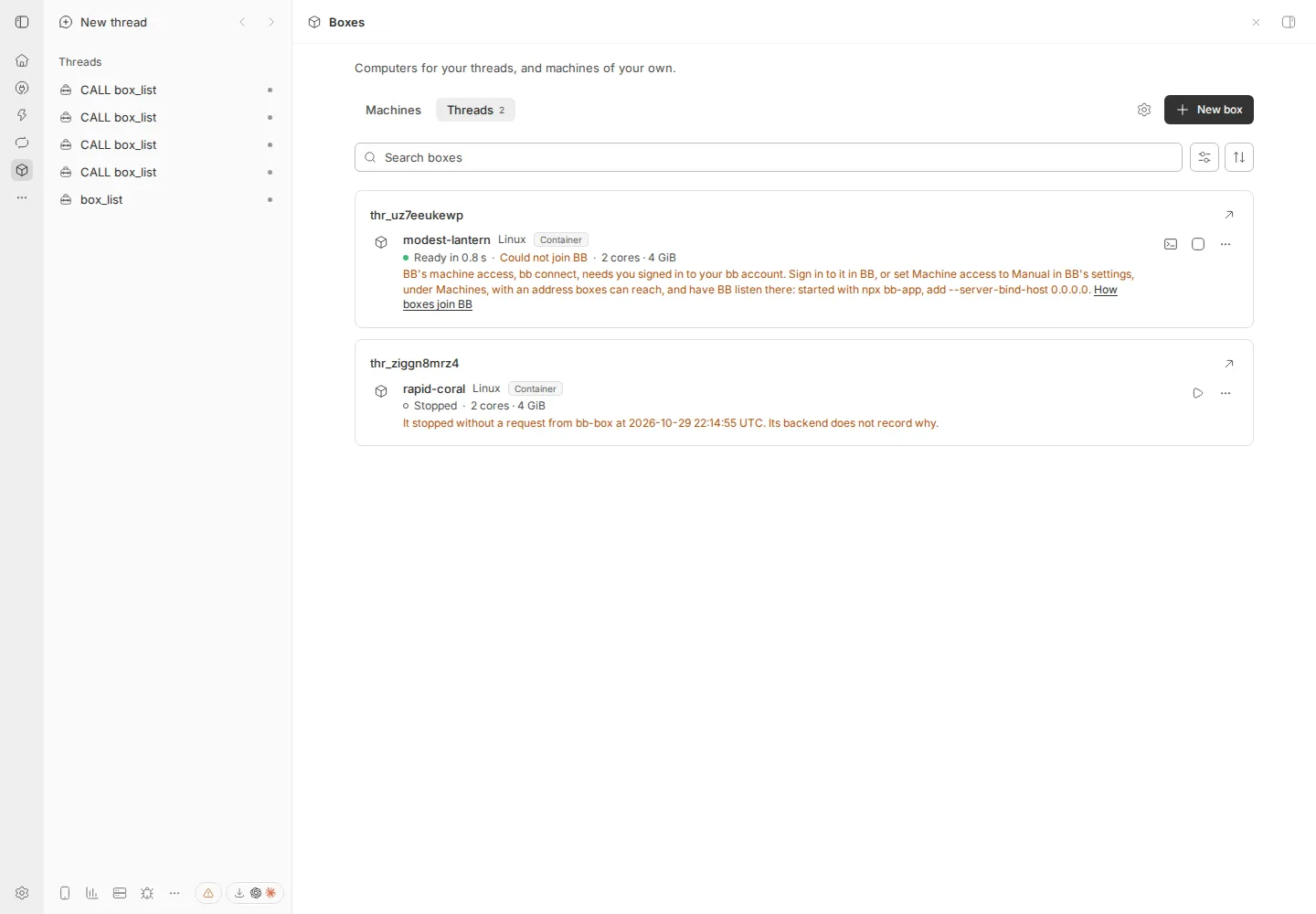
Outcomes and releases, on a second fresh BB set up the same way in the
same box, with machines of its own made by bb box machines add. These
ran on the change before an independent code review of it; after the
review’s fixes, bb-box was installed again on this BB from this branch
(0acd5011, the same change before its last rebases), and the stops above
(15 events, each with the same who), the stop that times out and the
interrupted release ran again, with the same results:
| Step | Result |
|---|---|
A stop that times out, then succeeds: the shim failed docker container stop with “timed out waiting for the container to stop” and stopped it 8 s later |
Logged “stop failed”, observed running, checked then by Docker on the box. The container exited; bb box sweep then logged “stopped” by the command, at the time it confirmed it, and no “stopped without being asked”; the failure left the view |
The box log made read-only: BB stopped, chmod 444 box-log.db, BB started |
bb-box started; its prune and writes failed and said so. The person’s Stop on the Boxes page stopped the box (the container exited). The view gave no last stop, although the log held an earlier stop by the person; the doctor failed: “bb-box could not write 2 events to its box log …”. With the file writable again and BB restarted, writes worked and the view still claimed nothing from before the failed writes |
BB killed between the container’s removal and the record’s: the shim held docker container rm for 40 s after removing it, and kill -9 stopped BB’s server then |
The container gone, the record releasing, “release asked” with no “released”. BB’s own supervisor started the server again in 2 s, before its BB machine reconnected, so the first sweep could not reach Docker and logged “release did not finish: sunny-canyon is offline in BB”, keeping the record. The next sweep, 3 minutes later, found the guest gone and logged “released” by the command that asked, “bb-box found its guest gone after a restart”, with no second docker rm |
| Forget while the backend is in settings | Refused: “release the box instead” |
| Forget after Docker was removed from the configuration (with BB stopped, from the stored document, as the settings refuse to remove a backend with boxes) | The view said not-in-settings. bb box forget logged “forgotten” by the command, with the box’s name, its backend and its last state, ready; no “released”, no stop. The record went; the container still ran |
A box that does not answer, for an hour. The script,
reach-hour.mjs, paused the box’s
container with docker pause (Docker then reads its power as unknown, so
the box stays ready), ran one bb box run, and read the view every 20 s
for 62 minutes. The Monitor was on for the first half and off for the
second; box history does not exist until unit 3.
| Time (UTC) | What happened | Docker calls on the box |
|---|---|---|
| 22:16:26 | Paused; bb box run failed: “Box modest-lantern is running but does not answer. The box … did not answer through docker exec.” The view: not answering, next check 22:17:26.206 |
the command’s 2 exec, and 1 container inspect, the failed command’s own power reading |
| 22:17:26.223 | Check 1 | 1 exec |
| 22:22:26.243 | Check 2, 5 minutes later | 1 exec |
| 22:37:26.262 | Check 3, 15 minutes later | 1 exec |
| 22:47:27 | The Monitor turned off | |
| 22:52:26.281 | Check 4 | 1 exec |
| 23:07:26.298 | Check 5 | 1 exec |
| 23:18:29 | Check now | 1 container inspect, 1 exec; still not answering |
| 23:18:29 | Check now again, at once | 1 exec, no power reading |
| 23:18:29 | Unpaused, then Check now | 1 exec: answers |
- In the hour, 6 lines for the box in BB’s log: the first failure and checks 1 to 5, at 1, 6, 21, 36 and 51 minutes.
- Each check came within 20 ms of the next check the view gave before it (22:17:26.206, 22:22:26.223, 22:37:26.243, 22:52:26.262, 23:07:26.281).
- From 22:16:27 until Check now, bb-box made no Docker call about the box
but one
execa check. Its backend’s listing, onecontainer lsevery 3 minutes for all its boxes, went on as before. - The checks went on the same with the Monitor off.
- This run was on the change before the review’s fixes; its words for a failed check, “It did not answer a command within 10 s.”, are now “It did not answer a command.”, as the check fails at once.
Deviations from 069
bb box stop,bb box startandbb box forget, and an RPCforget, are new: 069 names a stop by abb boxcommand and Forget, but no such command or call existed. Forget is refused while the box’s backend is in the settings.- A failed stop whose box is found stopped within 5 minutes of the failure, before any other stop or start, is logged as the asker’s stop, not as one bb-box did not ask for, unless the backend says the VM crashed. Before, such a stop was recorded as unrequested (#406).
- A claimed spare logs “made” by whoever asked for the box, with the spare’s name, so its last start names them, not bb-box’s spares.
- The reach check keeps “last answered” in memory only, so after a restart of bb-box it is unknown until a command answers. For a BB machine it asks BB’s connection state first, and when BB says it is connected, runs one command too, so a box that BB sees but bb-box cannot reach is still found.
- Check now’s limit of one power reading a minute applies only while the box does not answer; otherwise Check now reads its power as before.
- The sweep still lists each backend’s guests every 3 minutes, one call per backend, as before; the reach check adds no call per box.
- After a restart in the middle of a release, a sweep that cannot read the guest’s power, as while its BB machine reconnects, tries the release and logs it as not finished; the next sweep finishes it.
Open questions
- The Boxes list (
allBoxes,machines.list) still leaves out a box whose release did not finish, as it leaves out every releasing box. Its record and its view are kept, with the failure inlog.lastFailed; whether the list shows it, with Release again, belongs to unit 1c or 1d.
Follow-ups
- Unit 1c: the words for
logandreach;boxPagecan take a released or forgotten box fromapp.boxLog.ended(boxId); Forget… and Release again… call theforgetandreleaseRPCs. - Unit 3: box history’s tables, as migrations of
box-history.db; its readings report a box that does not answer toapp.reach.failed; a released or forgotten box’s points go with its log, 24 hours after. - A desktop viewer that cannot open its route does not yet report to the reach check; commands, terminals and the Monitor’s readings do.
Unit 1c: the box’s page
Built on 30 October 2026, on main e2d05767. Every box, and every
machine of your own, has a page of its own on the Boxes page, without
Activity, which unit 2 adds. Rows still unfold: unit 1d makes a row’s click
open the page.
What it adds
-
Paths. The Boxes page reads its path with
routeOfinsrc/app/box-route.ts:Path under /plugins/bb-box/desktop/Shows (none), threads,machinesThe list, as before box/<boxId>The box’s page box/<boxId>/desktop,/device,/terminalA view of the box The same, ending in from-list,from-boxorfrom-settings, innermost first, at most twoWhere it was opened from <threadId>/<boxId>[/device|/terminal][/from-settings]As before A path that is none of these opens the list.
-
Where each entry was opened from. BB’s plugin SDK 0.6.15 gives
toPluginPanel(path, { subPath, replace })and no state, as 069 said, so the origin is in the path (G8). The list’s quick icons and menu items open views withfrom-list; the page’s view buttons addfrom-boxbefore the page’s own origin; the Monitor’s views and Page, the Box panel’s item and a link carry none. -
The way back.
useBoxesNavinsrc/app/box-nav.tsxkeeps, in memory, the last move the panel made. When the way back leads to the entry that move came from, it goes back in history; otherwise it replaces the entry with the origin the path names. With no origin, a view goes back to the box’s page and the page to the list.from-settingsgoes back to BB Box settings. A view’s back arrow says where: “Back to boxes”, “Back to happy-beacon” or “Back to BB Box settings”. The box’s name in a view’s bar is a link to its page. -
boxPage, a new RPC: one box by ID, for any owner, with its view, its thread and whether it works (holderOf, new insetup.ts), the threads on its BB machine, its Monitor machine or why the Monitor cannot read it, a device that did not boot, and, for a box released or forgotten in the last 24 hours,app.boxLog.ended. Thechangedsignal for its thread, oroperator, refreshes it. -
The page,
src/app/box-page.tsx, with its words insrc/app/box-words.ts, in 069’s order: the trail; the header, with the name focused on opening, the state in words, the ID and Copy link, which copy with a click, and the thread with whether it works now, or “One of your machines…”; the views as links, so Ctrl-click or Command-click opens a new tab; Start or Stop; the menu; the notices; Starting while it starts; the eight facts; the other threads on it; and how it started, with the last start from the box log. Nothing slides or fades. -
Every state and notice of section 7 but busy: ready, starting the first time and again, stopping, stopped with when and by whom, stopped without being asked, a stop, start or resize that failed with what bb-box then observed, a release that did not finish, a backend not in settings, a box that does not answer with when bb-box checks again, a device that did not boot, a failed join, failed, releasing, gone, released, forgotten, and a link to a box that is not here. Words leave out a time or an actor the box log does not have.
-
The menu on the page (
BoxMenu’splace="page"): Copy address, New thread on this box…, Resize…, Check now, then Release…, Release again…, Remove… or Forget…. A machine of yours gets Check now there. -
A box whose release did not finish is listed again, by
allBoxesandmachines.list, with “Release did not finish” on its row and Release again… in its menu, never a spinner. A box being released is listed too, dimmed, until its release ends. -
G20, as the lead decided after the review. With its backend not in settings, or not answering (its listing of boxes fails in the sweep), Stop, Start, Resize… and New thread on this box are disabled, with the reason in words beside them on the page and in the menus, and a row has no quick Stop or Start. A box that does not answer itself keeps Stop, Start and Resize, which go through its backend: only its views and New thread on this box are disabled, and its notice says it can still be stopped, started or released. Its mark clears as soon as its record moves out of ready, or it answers.
-
G3. The panel’s
stopandreleaseRPCs ask first when the box’s own thread is working, as well as when a thread works on its BB machine, its own thread first, and when BB cannot say whether the thread works (“bb-box could not ask BB whether … is working on calm-otter”). A resize that needs a restart asks under the same guard. The question names the threads: “Fix the sign-in flow is working on calm-otter.” The agent’s tools andbb boxare unchanged. A machine of your own keeps today’s guard. -
Entries. “Page” is the first item of the Monitor’s Open menu, which now shows for a box with no view too; “N more on the Boxes page” opens the box’s page; the Box panel’s menu has “Open on the Boxes page”.
-
MachineRow’s settings mode is gone (the lead’s answer: settings names no machine since 067, and gets no new entry). -
The guide’s Box panel and Boxes page chapter has a section on the page.
docs/bb-requests.mdhas request 37 (below).
Files: new src/app/box-route.ts, box-nav.tsx, box-words.ts and
box-page.tsx; changed box-menu.tsx, box-actions.tsx, box-row.tsx,
settings-machines.tsx, desktop.tsx, terminal.tsx, panel.tsx,
status.ts, monitor/box-screens.tsx, monitor/status.tsx, and
src/plugin/contract.ts, rpc.ts, setup.ts and monitor.ts.
Checked
On a Linux box, 8 cores, on the commit delivered: tsc clean; the node
suite 2,874 tests, 2,586 passed, 288 skipped, 0 failed, the docs and site
tests among them; vitest 332 tests passed in 4 files;
scripts/reference.ts --check passes. New tests:
test/box-route.test.ts: every path of section 1 and the old ones read and written back, a wrong path opens the list, the way back for each origin, and the words of section 7 and 11 with a set clock.test/plugin.test.ts: G3 through the panel’s RPCs, with the box’s own thread working, then also a thread on its BB machine, then forced, then idle;boxPagefor a box, a box whose release failed (listed byallBoxes), a released box, an unknown ID and a machine.test/app.test.tsx: the page’s header, links, menu, facts, threads and how it started; the way back going back in history only after the panel’s own move; G3 from the page; G20 on the page and a row’s menu, with Forget…; a release that did not finish on the page and its row; a link to a box that is not here; a machine’s page; the Starting card; a device that did not boot, a failed join, a gone box and a failed one.test/monitor-app.test.tsx: Page first, the views’ new paths, and “N more” opening the box’s page.
Live check on a separate BB
A Linux box with Docker 29.1.3, 8 cores, 16 GiB, ran a fresh npx bb-app
0.48.0 with no account, its own data folder and ports, started with
env -i, HOME and PATH only, set up by
live-setup.sh. bb-box was
installed from this branch with bb plugin install path:, and Docker on
the box set up with bb box setup docker. So that boxes join BB without an
account, BB listened on all addresses, closed to the network outside the
box by its firewall, with Machine access set to Manual at the box’s own
address: every box joined BB. A shim first on BB’s PATH,
docker-shim.sh, logs every
Docker call; on a flag it fails one start, one stop or one removal, makes
docker exec into one container hang, as a hung box does, or makes
docker container ls fail, as a Docker daemon that does not answer does.
The agent is unit 1b’s custom ACP agent, which calls BB’s box tools as a
prompt names them, driven by
agent-call.sh. The boxes, made
through bb-box:
- for the thread, by the agent’s
box_acquire: clear-finch (the page’s box), polite-dune (the one that hangs), and in each run two more, one released from its page and one whose start fails and which is then forgotten; - a machine of your own, by
bb box machines add: workbench.
live-check.mjs, with
live-lib.mjs and
runs.sh, drives headless Chromium at
1440 by 1000 and checks each result through the page and bb-box’s own
state. Three runs in a row on the commit delivered each passed 33 of 33
checks: run 1,
run 2,
run 3. (The first delivery’s three runs
passed its 31 checks each, on a first fresh BB.)
| Check | Result, each run |
|---|---|
| A link | the page, with focus on its name |
| The Box panel’s Open on the Boxes page | the page; its menu: Open terminal, Open on the Boxes page, Copy address, New thread on this box…, Stop, Resize…, Check now, Release… |
| The Monitor’s Open menu | Page, Open terminal, then the thread; Page opens the page |
| The box’s name in a view’s bar | the page, keeping the view’s origin: box/<id>/from-list |
An old path, <thread>/<box>/terminal |
its back arrow, “Back to clear-finch”, replaces it with the page |
An old path with from-settings |
its back arrow is a link to BB Box settings |
| Reload | the page again, its name focused |
| Page, Terminal, browser Back, Forward, then the view’s back arrow | Back, Forward and the arrow agree, and nothing is pushed twice: the history’s length stays |
| A reload on the view, then its back arrow | replaced with the page; Back then goes to the entry before the view |
| Ctrl-click on Terminal | a new tab at box/<id>/terminal/from-box, whose back arrow replaces it with the page |
| Keyboard only | Tab from the name: Box ID, Copy link, the thread, Terminal, Stop, the menu, then the facts; Shift-Tab reaches the trail; Enter on Terminal opens it; in the terminal, 12 presses of Shift-Tab stay in the shell (an open question below); the browser’s Back returns to the page with focus on its name |
| Working now | with the page open on clear-finch, “idle” turned to “working now” within 15 s of the agent starting a box_run there, with no reload |
| Stop, Start and Release from the page | stopped “just now, today at 2:21 AM, by you”, started, “Last started … by you: ready in 0.3 s”; released, “Released just now, … by you”, also after a reload and after bb plugin reload bb-box |
| A failed stop, then the box stopped outside bb-box | “Stop failed just now”; after docker stop and bb box sweep, “Stopped” and no failure beside it |
| A start that fails | “Start failed just now”, Docker’s words, “It is still stopped (checked 2:22 AM).”; Start again starts it |
| A failure, said | the page’s one announcer said “Stop failed. …” once, and nothing on opening; no notice has a live part |
| A release that does not finish | “Release did not finish”, Docker’s words, on the page and the row, with Release again…, which then released it |
| A backend removed from settings, with bb-box off, from its stored configuration | “Not checked · last seen ready”, the notice with Open BB Box settings and Forget…; Forget…: “… was forgotten: bb-box removed its record. Its box was not deleted and may still run on crisp-petrel”, its container still running; the same after a reload and after bb plugin reload bb-box; the container then removed and the configuration put back |
| Gate | Result | What each run did |
|---|---|---|
| G3 | 3 of 3 | With the agent in box_run on clear-finch, Stop from its row, its row’s menu, its page and a failed stop’s Stop again each asked “Stop clear-finch anyway?”, “CALL box_list is working on clear-finch.”, with the thread’s chip; Cancel left it ready; Stop anyway stopped it. With the thread idle, Stop stopped it at once. workbench, with no thread on it, stopped at once |
| G6, words | 3 of 3 | A stop Docker refused: “Stop failed just now”, Docker’s words, “It is still running (checked 2:21 AM).”; a start Docker refused: “It is still stopped (checked …).”; “still stopped” only with an observation |
| G8 | 3 of 3 | A row’s quick Terminal and back: the list, by going back in history; after visiting another box’s page, a quick icon and back: the list; settings, workbench’s page with from-settings, Terminal and back: the page, then settings, also after a reload on the view; a page opened by URL, then Boxes, then browser Back: not the page; a row’s quick Terminal, a reload, then back: the list |
| G20, as the lead decided | 3 of 3 | polite-dune, whose docker exec hangs: “Not answering”, its notice saying it can still be stopped, started or released, Stop enabled on its page and row, “Terminal is off: polite-dune does not answer.” beside the actions, New thread on this box… disabled with that reason; Stop from its page stopped it, and its mark cleared. With docker container ls failing and a sweep: “Not checked”, “Docker on crisp-petrel does not answer”, Stop disabled, “Terminal and Stop are off: Docker on crisp-petrel does not answer.”, New thread on this box… and Resize… disabled with it in the page’s menu, Stop and Resize… in the row’s, no quick Stop; all back after the next sweep listed again. A box whose backend was removed: the same with “its backend is not in settings”, Runs on saying “Backend not in settings”, and Forget… last |
Screenshots
At 1440, 760 and 390 px, light and dark, from the live BB: the
ready page
(dark,
760,
760 dark,
390,
390 dark),
stopped
(390 dark), a stop that
failed, the G3
question, a start that
failed, a release that
did not finish,
released (390
dark), a box that
does not answer (390
dark), a backend that
does not answer (390
dark), a backend
not in settings
(390 dark),
forgotten, a machine
from settings, and a view’s
bar (390
dark). A fourth run on
this delivery took them, with its screenshots on (its two G3 checks failed
there, as resizing the window for a screenshot closes the open dialog);
shots-stopped.mjs took the
stopped page’s.


Not checked live, and why
- A device box’s page and views, and a device that did not boot: they need a Mac or a Linux host with KVM. The page’s tests cover them, and its Simulator link.
- The Starting card: a Docker box starts in under a second. Its test covers the first start and a start again.
- A failed join, and a gone box: here every box joined, and none was deleted outside bb-box. Their tests cover them.
- Focus back on the row after a view’s way back, which is unit 1d’s G9: here it goes back to the list, where 1d keeps the row.
Deviations from 069
- No settings entry: settings names no machine since 067, and the lead
chose to add none.
from-settingsworks on every path, new and old, and G8’s settings case ran from such a link opened from the settings page.MachineRow’s settings mode went. - The way back to settings is a link, so it pushes BB Box settings rather than replacing the entry: BB offers no replace for its own app paths.
- “Its host does not answer” names the box, as “calm-cedar does not answer”, with its host in the words, as the reach check tests the box itself and cannot tell a host that does not answer from a box that does not. A backend that does not answer is told by its listing failing in the sweep, every 3 minutes, so it can take up to 3 minutes to show, and to clear.
- Every box being released is listed, dimmed, not only one whose release failed.
- A view by box ID waits for
boxPageto learn the box’s thread. - The Terminal button shows, disabled, whenever a box is not ready, as a stopped box’s view does not say whether it has a terminal.
- A shared slot’s Size is “A share of mac-1”, without the Mac’s cores and memory, which the box’s view does not have. The Address’s tailnet name waits for unit 2’s readings.
- Open in browser still opens the old path, which keeps working.
- The page’s links stop a click with Ctrl, Command, Shift or Alt held, or
another button, going further: BB 0.48.0 routes every link to an app
path in its panel in the same tab, so the browser could not open the
new tab (request 37 in
docs/bb-requests.md).
Open questions
- From a terminal view, Tab and Shift-Tab go to the shell, as xterm keeps them, so the back arrow cannot be reached from the keyboard there; the browser’s Back works. This predates the page (035). Should a terminal give a key to leave it, for keyboard-only use?
Follow-ups
- Unit 1d: a row’s click, name and chevron open the page, with
from-list, and focus returns to the row. - Unit 2: Activity can read
boxPage’smonitor; an offline BB machine gets the words “is not a BB machine” there now. - A view whose box’s backend is not in settings, or which does not answer, still tries to connect; it could say why first, as the page does.
- A forgotten box whose guest still runs comes back when its backend is put back in settings: the sweep restores its record from the guest (019), and lists it again. Forget is meant for a backend gone for good; 069 and the guide could say so.
- A resize that needs a restart is not checked live here: Docker resizes cores and memory live. Its test covers the guard.
After the independent review
The review of the first delivery (PR 1291) said to merge after fixes. Each fix has a test; the lead decided points 1 to 3.
| # | Finding | Fix | Test |
|---|---|---|---|
| 1 | G20 turned off Stop, Start and Resize for a box that does not answer, though they go through its backend | Only a backend not in settings or not answering turns them off. bb-box now records a backend whose listing fails in the sweep (Boxes.backendSilence), and the box’s view says backend-silent. A box that does not answer keeps them, and its mark clears when its record moves out of ready (ReachCheck.settled). Its notice: “bb-box cannot reach it …, so it cannot read it or run commands in it. You can still stop, start or release it: those go through Docker on devpc.” Section 7 and G20 of 069 say so, as the lead’s decision |
plugin.test.ts: a box that does not answer stops through its backend and its mark clears; a backend whose listing fails, then lists again. box-route.test.ts and app.test.tsx: the words, the menus and the page |
| 2 | The G3 guard let Stop and Release through when BB’s thread lookup failed | holderOf throws on any error but a missing thread; the guard then asks, saying bb-box could not ask BB. boxPage still shows no thread then |
plugin.test.ts: with BB’s lookup failing, Stop and Release ask; with the thread gone, Stop goes on. app.test.tsx: the question’s words |
| 3 | A resize with a restart did not ask while the box’s own thread worked | Its beforeRestart uses the same guard as Stop and Release |
plugin.test.ts: it asks, then restarts when forced. The resize dialog’s words name the thread |
| 4 | “Starting again” showed the last start’s steps, and Total, as done | A start clears the last start’s start.* timings when it is asked; the card shows only what it waits on; startSteps leaves out Total |
plugin.test.ts: no step of the last start while one is under way. app.test.tsx: the card |
| 5 | Notices were live regions whose words changed with the clock | Notices are sections with a heading. One polite announcer, always in the page, says a notice once when it appears or changes in substance, never on opening and never as the time moves; the countdown is plain text apart from the words | app.test.tsx: no live part in a notice; a new failure said once; 61 s later the announcer says nothing new |
| 6 | A failed stop or start stayed beside a state that contradicted it | A failure shows only while the box is still as bb-box observed it then, and until a later stop or start | box-route.test.ts; live: a failed stop, then docker stop outside bb-box, and the notice goes |
| 7 | A release whose failure the log lost showed “Releasing…” for ever | A releasing box with an error is a release that did not finish: its words, and Release again… | box-route.test.ts, app.test.tsx |
| 8 | Disabled reasons were only a hover title | The reasons are words beside the actions (“Terminal and Stop are off: its backend is not in settings.”), linked to the buttons with aria-describedby; a notice’s disabled button has its reason beside it |
app.test.tsx; live |
| 9 | Working now and the threads went out of date | An open page asks boxPage again every 15 s while it is shown |
app.test.tsx; live: “working now” appeared within 15 s of the agent starting, with no reload |
| 10 | The working spinner ignored reduced motion | WorkingMark stops under reduced motion |
app.test.tsx |
| 11 | A view opened by box ID had no way back while loading or on error | It shows the trail and its way back meanwhile | app.test.tsx |
Rebased onto main 50b110a7. On a Linux box, on the commits delivered:
tsc clean; the node suite 2,882 tests, 2,594 passed, 288 skipped, 0
failed, the docs and site tests among them; vitest 338 tests passed in 4
files; scripts/reference.ts --check passes. The live check below ran on
the same code before that rebase, whose only change beside it is in the
boat backend.
The live check ran again on a second fresh BB 0.48.0 set up the same way,
now by live-setup.sh with
agent-call.sh. The shim gained
two flags: one makes docker exec into one container hang, as a hung box
does, and one makes docker container ls fail, as a Docker daemon that
does not answer does. A paused container cannot be stopped by Docker at
all, so the hung box is made this way.
Unit 1d: the list opens the page
Built on 30 October 2026, on main 635707e5. On the Boxes page, a row
opens the box’s page. Its details no longer unfold there. The list keeps
its place for the way back.
What it adds
- A row opens the box’s page. On both tabs, a click anywhere on a row
that is not one of its controls, its name and the chevron at its end
each open
box/<boxId>/from-list. The name is a link: Tab reaches it, Enter opens the page, and Ctrl-click, Command-click or a middle click is left to the browser. The chevron comes last, after the menu, and is the same link, out of the tab order and hidden from screen readers. A row whose text is being selected does not open the page, and a click inside a row’s menu or dialog, which React passes up to the row, is not a click on the row. - The inline details are gone from the Boxes page. The box’s page has them and more.
- Hover shades the row lightly, edge to edge in its card, and brightens the chevron; nothing moves. The row stays shaded while its menu is open.
- The list keeps its place.
src/app/list-place.tskeeps the search, filters, sort, scroll and the row last left in module memory, as 067 keeps drafts, and in session storage, so a reload keeps them too. The tab is kept in local storage, as before. What it reads back from storage is checked, and anything that is not a place is dropped. - Every way out of a row records it first: its click, name and chevron, its quick icons, its menu’s views, and on the Machines tab its thread chips. Each records the box, its position in the list and the list’s scroll.
- The way back. When the list opens again on the tab it was left from, it puts back the scroll and focuses that row’s name. If the box has gone, it focuses the row now in its place. The list first shows the rows it remembers, then asks for fresh ones; if a fresh list drops the row that had focus, as after a release from the page, focus moves to the row now in its place. With a search set, the list waits for the threads’ titles before it puts its place back, as a search can match a title; titles are now remembered across visits.
- The search row and tabs stay above the scrolling rows, as before, at 1440, 760 and 390 px.
- The guide’s Box panel and Boxes page chapter says how a row opens the page, and what the list keeps.
Files: new src/app/list-place.ts; changed src/app/box-row.tsx,
settings-machines.tsx, desktop.tsx, box-nav.tsx, thread-chips.tsx
and panel.tsx, docs/guide/boxes.md, and test/app.test.tsx. No server
change.
Scope
The thread’s Box panel keeps unfolding a row’s details in place, and
“Open on the Boxes page” stays in its menu (the lead’s answer on 30
October 2026). Only the Boxes page’s rows open the page. BoxRow takes
either way of opening.
Checked
On a Linux box, 8 cores, from a clone of the delivered bundle: tsc
clean; the node suite 2,882 tests, 2,594 passed, 288
skipped, 0 failed, the docs and site tests among them; vitest 351
tests passed in 4 files; scripts/reference.ts --check passes. New tests
in test/app.test.tsx:
- a row’s click, name and chevron open the page with
from-list; a modified click is left to the browser; Stop and the menu’s Check now do not open it; no row unfolds on the Boxes page; the chevron is last, out of the tab order and hidden from screen readers; - with a search, a filter and a sort set, opening a box by its name, its chevron, a quick icon and its menu, then coming back: all three kept, the same rows in the same order, and focus on that row’s name, each way;
- a box released while away: focus on the row now in its place, also when the list first shows the remembered rows and the fresh list drops it;
- a machine’s row opens its page, and a thread chip records the row;
- the place survives a reload through session storage, its scroll only for the tab it was on, and junk in storage is dropped.
The tests that read the Boxes page’s rows by their old details buttons now read the name links. The Box panel’s tests are unchanged.
The live check below ran on the same code before the rebases onto
1e8de9d9 and 635707e5, which change the docs site, guides, demo and
the Monitor’s machine threads, none of this unit’s files.
Live check on a separate BB
A Linux box with Docker, 8 cores, 28 GiB, ran a fresh npx bb-app 0.48.0
with no account, its own data folder and ports, started with env -i,
HOME and PATH only, set up by
live-setup.sh, as unit 1c’s
was. bb-box was installed from this branch with bb plugin install path:.
Unit 1b’s custom ACP agent, driven by unit 1c’s agent-call.sh, made the
boxes through BB’s box tools: three threads with three Docker boxes each,
and bb box machines add made workbench. (The box first had 16 GiB, which
held 7 of these boxes; it was grown to 28 GiB and the last two made by
hand with the same commands.)
live-check.mjs, with unit 1c’s
live-lib.mjs and runs.sh, drives
headless Chromium. Each run stops one box if none is stopped, then on the
Threads tab sets the search to “docker”, ticks Ready under Filters, sorts
by Created, descending, and scrolls the list half way (108 of 216 px at
1440 by 640). It then opens a box each way and returns each way, and after
each return checks, through the page itself: the list’s path, the search
text, the filter, the sort, the tab, the same rows in the same order, the
scroll within 2 px, the search row in the same place and outside the
scrolling rows, and focus on that row’s name link. The box it opens
rotates among the rows fully in view. Three runs in a row on the commit
delivered each passed 18 of 18 checks:
run 1,
run 2,
run 3.
| Gate | Result | What each run did |
|---|---|---|
| G9 | 3 of 3 | At 1440 by 640: a box opened by its name, its chevron, a quick icon (Open terminal) and its menu (Open terminal), and each returned by the trail, the browser’s Back and a view’s back, 12 ways: all four kept and focus on that row’s name, every time. From the page, “the trail” is its Boxes link and “a view’s back” is Terminal, its back arrow to the page, then the trail; from a view, “the trail” is the box’s name in the view’s bar, then the page’s Boxes link |
| G9, release | 3 of 3 | A box released from its page, then the page’s Boxes link: the box gone from the list, focus on the row now in its place, search, filter and sort kept. Each run then made a new box for the thread, so every run starts alike |
| G9, 390 px | 3 of 3 | At 390 by 700, scrolled half way: name and the trail, chevron and Back, quick icon and the view’s back, menu and Back: all four kept, focus on the name |
A Back pressed in the same instant as a click on a quick icon, before the list has gone from the page, leaves focus on the button clicked, as the list never left. The check waits for the view to show before going back, as a person does.
Keyboard
Each run, at 1440 px, from the search field: Tab reaches Clear search, Filters, Sort, the first thread’s title, Open thread, then the first row’s name; Enter opens its page with focus on the box’s name; Shift-Tab reaches the trail’s Boxes link; Enter returns to the list with focus on that name; Tab then reaches the row’s Open terminal; Enter opens the terminal; the browser’s Back returns to the list with focus on the name again. The chevron is never reached by Tab.
Screenshots
From the live BB, the list kept and scrolled after a return, at 1440 by 640: light, dark; 760: light, dark; 390: light, dark. Returned by the keyboard, with focus on the row’s name: light, dark; hover: light, dark; the page opened from the list: light.


Not checked live, and why
- The Machines tab’s ways back: the live BB had one machine, so its list cannot scroll. Its row’s click, name, chevron and thread chips are covered by tests, and the same code keeps the place for both tabs.
- A device box’s row: it needs a Mac or a Linux host with KVM. Its quick icon and menu open views through the same recorded ways as a terminal’s.
- A look in production in the owner’s browser waits for the lead’s deploy.
Deviations from 069
- The search, filters and sort are shared by the two tabs, as before; the scroll is kept for the tab it was on. The tab itself stays in local storage, as before, so it lasts beyond the browser tab’s session.
- The chevron is a second link to the page, so it is out of the tab order and hidden from screen readers; the name is the one link they reach.
- The name link’s accessible name is the box’s name alone, as the old details button’s was; the system and badges are read in the page’s text.
- The lines between rows now run the card’s full width, as in the prototype, since the hover shade runs edge to edge.
- Focus returns once: the first time the list opens again on the tab a row was left from, by any way, BB’s sidebar included. After that, opening the list moves no focus.
Open questions
- A thread with no title of its own heads its card with its ID, as BB’s thread title is empty until it has one; BB’s sidebar shows the first prompt instead. This predates 1d. Should the card fall back to the same words as the sidebar?
Follow-ups
- Unit 4 can sort by Last active through the same kept sort: a stored sort whose key a later build drops falls back to Name.
- The terminal keeps Tab, so its back arrow cannot be reached from the keyboard (unit 1c’s open question); the browser’s Back works and now lands on the row’s name.
Unit 2: Activity on the box’s page
Built on 30 October 2026, on main 7647080c. A box’s page now shows how
the box is doing now: Activity, read through the Monitor, and its top
processes. The lead chose Live only until unit 3 brings box history (see
Decided during unit 2).
What it adds
- Activity (
src/app/activity.tsx, words inactivity-words.ts). It readsboxPage’smonitor, which now says what it is (read,off,not-runningorunreadable), and reads the box through the Monitor’s ownuseMonitorSnapshot, so the page and the Monitor share one reading. The card’s heading has “Read at 5:18:24 AM”.- Four tiles: CPU with the load, or the pressure in a container; memory with Normal, High or Critical; free disk with its size; network down and up. A fifth for a GPU where the reading has one.
- The chart (
src/app/history-chart.tsx): CPU and memory as % used over the last 72 readings, placed by time, a gap where a reading failed or came late, ticks every 2 minutes, legend chips that hide a line, and the Monitor’s colours in a darker tone on the light theme (CPU#15803d, memory#a16207, download#1d4ed8, upload#6d28d9, the Mac#525252). Memory and upload are dashed, the Mac long-dashed. Network below, on its own scale, with the same width. - Reading a point: hover, or with focus Left and Right, Page Up and Page Down by 10, Home and End, Escape to clear; none scrolls the page. A polite live region, always in the page, says each point.
- Each chart is described by its numbers: “Over the last 6 min, every 5 s: CPU averaged 31%, highest 78% at 4:10:05 PM; memory last 58%”, and the network’s averages and highest points, with the gaps (G17).
- The charts hold the reading they had while focus is on them, and say “Held at 5:18:24 AM while you read it”.
- Not read: the Monitor off, with “Turn it on in Monitor settings”
(linking to
#option/monitor); a stopped box, “amber-coral is stopped, so bb-box is not reading it. It stopped 3 min ago, today at 5:18 AM.”; a box it cannot read, with the Monitor’s words. A reading that fails after one worked keeps the numbers under “Can’t reach amber-coral. Showing data from 5:18 AM.” - G16: a stopping box stays readable (
readableStateinsrc/plugin/monitor.ts), so Live goes on until the stop is confirmed.
- Top processes: name, PID, CPU and memory; 100% or more in amber; the PID column goes below 640 px; long names cut in the middle; the note that CPU is per core and that bb-box reads names and PIDs only.
- A shared slot (G1, G2). Its reading adds
own(its user’s CPU in cores and memory) to the snapshot and to each history point, andslot.share: the Mac’s cores and memory divided by the slots it can hold (the placement’smost). Its health is judged on its own numbers against its share, never the Mac’s; without its own reading, its CPU and memory are not read and only the shared disk can warn. The page shows “This slot’s CPU”, “This slot’s memory”, “mac-1, all slots” (busy at 85% CPU or a load of its cores), “mac-1’s encoder” and “mac-1’s disk”, the line that says how it is judged, the slot’s chart with the Mac’s CPU as a third line, hidden at first, and “This slot’s processes”. - How a slot is read (
src/monitor/own-usage.ts). On a Mac, a few lines of Python run by/usr/bin/python3read, for each of the slot user’s processes,proc_pid_rusage’s own CPU time, children’s CPU time, memory footprint and start, into the whole 160-byterusage_info_v2with a canary after it, andproc_pidinfo’s parent. It runs only wherexcode-select -pfinds Xcode or the command line tools, as without them/usr/bin/python3asks on the Mac’s screen to install them; otherwise, and where Python fails,psis read, without exited children. The host entry and the command route both use it. Between two readings, CPU is each process’s growth, a process known by its PID and start; a process that ended is owed by its nearest running ancestor and settled against that ancestor’s children’s growth for at most two readings; a change of reader starts a new baseline (see the decision’s section). - The follow-ups from unit 1c’s look in production:
- Activity reads the Monitor data the page already has; an enrolled box whose BB machine is offline and has no shell route now says “its BB machine is not answering BB”, not “it is not a BB machine”.
- The two “up” times: the Monitor’s label for a box now says whose clock it counts, “system up” or, for a container or shared slot, “host up”; the page’s “up” stays from the last start. The guide says so.
- How it started for a claimed spare: a spare that keeps its name is
named after it is ready, so that step leaves the bar and the longest
steps, and a line says “Once it was ready, bb-box named it for its
thread in 0.3 s.” (
namedAfterReady). - A thread with no title: the SDK 0.6.15 gives a thread’s
titleFallback, which BB’s sidebar shows (its first prompt), so the Threads tab’s card is headed by it, then by the ID only when it has neither.
- The page’s headings, the box’s name and notices’ titles are set at weight 400, as the owner’s style guide asks; the chart’s tooltip has a border and no shadow.
- The guide’s chapter on the Boxes page has a section on Activity; the Monitor’s chapter says what its “up” counts and how a slot’s health is judged. 069 has a section, Decided during unit 2.
Files: new src/app/activity.tsx, activity-words.ts,
history-chart.tsx and src/monitor/own-usage.ts; changed
src/app/box-page.tsx, box-words.ts, desktop.tsx,
monitor/status.tsx, src/monitor/collector.ts, route.ts,
snapshot.ts, and src/plugin/contract.ts, monitor.ts, rpc.ts and
setup.ts.
Checked
On a Linux box, 8 cores, in a clone of the commit delivered: tsc clean;
vitest 373 tests passed in 5 files; the node suite 2,916 tests, 2,628
passed, 288 skipped, 0 failed, the docs and site tests among them;
scripts/reference.ts --check passes. (Before main’s fix to the reach
check’s timing, #1301, its G7 test failed here once in 9 runs.) New tests:
test/own-usage.test.ts: ps’s CPU times in both forms; the Mac reader’s shape, its guard and itspsfallback; that the host entry never runs/usr/bin/python3wherexcode-select -pfails, and looks again after 10 minutes; CPU between readings; children that exit into a live parent; a build service its tool did not wait for; a new process, a reused PID and a tree that ends whole; G1’s share (2 of 4 cores is 50%) through the command route; a busy Mac leaving a calm slot healthy.test/activity-words.test.ts: Live’s window and ticks; gaps; the chart’s and the network’s summaries (G17); the read-out’s words; a slot’s words; sizes and rates; a spare named after it was ready.test/activity.test.tsx, the page in the SDK’s harness: the tiles; the charts’ names and summaries; the read-out’s keys and live region; a hidden line; the processes; a slot’s tiles (G1); the Monitor off; G16 through a stop; a box it cannot read; a failed reading; the charts held while focused; the Monitor’s up labels; the untitled thread’s words.test/monitor.test.tsandtest/plugin.test.ts: a slot’s share in the reading;boxPage’smonitor.isand the offline machine’s words.
Live check on a separate BB
A Linux box, 8 cores, 16 GiB, ran a fresh npx bb-app 0.48.1 with no
account, set up by live-setup.sh
as unit 1c’s was, with bb-box installed from a clone of this branch and
Docker on the box as its backend. The agent’s box_acquire made
amber-coral, a Docker box of 4 cores and 2 GiB, and a BB machine.
live-check.mjs drives headless
Chromium. Run 1, on a first build
before the slot reader’s and the chart’s fixes, passed its 9 checks;
run 2 and
run 3, on the code delivered, passed 10
of 10 each, the tenth being the untitled thread’s card.
| Check | Run 2 | Run 3 |
|---|---|---|
CPU: stress-ng --cpu 2, typed into the page’s own Terminal view with top -d 5 beside it, against top -b -d 5 in the box over 40 s. top’s figure is every process’s %CPU over the box’s 4 cores; its %Cpu(s) line is the host’s, not the container’s |
page 48.2% (9 readings), top 47.7% (8 frames): 0.5 points |
page 49.2%, top 49.9%: 0.7 points |
| Processes | stress-ng twice, at 97.5% and 92.0% | the same |
The Monitor off, then on (bb box option set monitor.enabled=…) |
the off words and the settings link within seconds, the processes gone; Live back on | the same |
| G16: Stop with Docker’s stop slowed by 20 s | “Read at 5:18:37 AM”, then “Read at 5:18:47 AM” while Stopping; then “amber-coral is stopped, so bb-box is not reading it. It stopped just now, today at 5:18 AM.” | the same |
| Started again | Live back on its own | the same |
A failed reading (docker pause) |
“Can’t reach amber-coral. Showing data from 5:18 AM.”, the last numbers kept | the same |
| The keyboard | role application, “chart”; held while focused; End “5:18:24 AM: CPU 45%, Memory 19%”, Left the reading before; Page Down did not scroll |
the same |
| The untitled thread’s card | headed “CALL box_list”, its first prompt, not its ID | the same |
Run 1, on the first build, had the same results (CPU gap 0.3 points).
Gates
| Gate | Result | How |
|---|---|---|
| G1 | Passed, on a 12-core host holding up to 9 slots, not a 12-core Mac with 3 | No free 3-slot Mac: the pool’s Mac was lent whole to another box, and the Namespace Mac gave no second slot twice (see Follow-ups). Three slots on one Tart shared iOS host, 12 cores and 22 GiB, which holds up to 9, so a share is 1.33 cores. This branch’s collector ran in each slot, as the host entry does, every 5 s. With the host at 88 to 100% CPU from the other two slots (their new simulators kept it near a load of 20), the quiet slot read 2 to 13% of its share throughout. The loaded slot read 10.5 cores, 787% of its share and 87% of the host, under 10 busy processes. A slot over its share is judged on its own numbers (tested), and the 2-of-4-cores case is tested through the command route; it could not be reproduced on a 9-slot host |
| G2 | Passed against the Mac’s own counters; time xcodebuild cannot be the yardstick |
In a Namespace slot, an xcodebuild of a Swift package of 360 files for the iOS Simulator, run from a shell that stays open, as a terminal is. Over the build the slot read 36.1 CPU-seconds above its idle level; the Mac, with no other slot busy, 36.5: 1% apart. time xcodebuild reported 1.1 s, as Xcode’s build service, which runs the compilers, is not a child xcodebuild waits for. With ps -S, as 069 first said, the slot read almost nothing of the build: macOS 26’s ps -S adds no exited child’s time. Unit 3’s history part waits for unit 3 |
| G16 | Passed | Above, three runs |
| G17 | Passed in tests and with NVDA | NVDA read “Download and upload, the last 6 min, every 5 s”, then “download averaged 957 B/s, highest 5 KB/s at 4:56:28 AM; upload averaged 1.1 KB/s, highest 5.3 KB/s at 4:56:28 AM” |
The guard, on a Tart shared iOS slot with Xcode 27, the command route’s
whole script for a slot run by sh and by zsh: with Xcode there, the
Python reader answered for 151 processes; with an xcode-select that
fails first on the PATH, ps answered, and Python was not run.
Screen readers
NVDA 2026.2, portable, in Edge on a Windows desktop box, with its speech logged (what it said). The first look found two faults, both fixed: as an image, the chart kept NVDA in browse mode, so the arrow keys moved NVDA’s own cursor and never reached the read-out; and NVDA said the chart’s summary again at every reading, as it changed while focused. After the fix, Tab from the box’s name reached the ID, Copy link, the thread, Terminal, Stop, the menu, the legend’s CPU and Memory (“toggle button, pressed”) and the chart: “CPU and memory, the last 6 min, every 5 s, chart”, then its summary; End said “4:59:15 AM: CPU 0%, Memory 30%”, Left the reading before, Home the first, and nothing more was said while it waited. Page Up and Page Down did not reach the page through the desktop tool’s key names; they are checked in Chromium.
VoiceOver was not checked: a Mac desktop box on Tart cannot reach the
separate BB’s network, the Namespace and pool Macs were not free as
desktops, and a fresh BB on a Mac box has no backend to make a box with.
NVDA stands in, with the attributes VoiceOver reads (application,
aria-roledescription “chart”, the summary by aria-describedby, a
polite live region) under test.
Screenshots
From run 2, at 1440, 760 and 390 px, light and dark: under load
(1440,
dark,
760,
760 dark,
390,
390 dark); the Monitor off
(1440,
dark,
390 dark); stopped
(1440,
760,
390 dark); stopping
(1440); a failed reading
(1440); the box’s terminal
with top (1440); and the
Threads tab (1440). The
others of each set are in the same folder. No shared slot is shown: none
was read by the separate BB.


Not checked live, and why
- A shared slot’s page in a browser: the separate BB has no Mac. Its numbers were measured in real slots with this branch’s collector; its tiles and words are covered by tests.
- VoiceOver: above.
- A GPU tile, and a box read through its command route rather than as a BB machine: the box here was a BB machine with no GPU. Their tests cover them.
- The spare named after ready, and the Monitor’s “system up” and “host up”: no spares were kept on the separate BB, and the Monitor’s machine status was not opened there. Both have tests, and both show in production: a claimed Windows spare this thread used said “naming it for its owner 0.3 s” after its total.
- A look in production in the owner’s browser waits for the lead’s deploy.
Deviations from 069
- No range group until unit 3, by the lead’s decision; G16 reads as above.
- A slot’s own CPU is read with
proc_pid_rusage, notps -S, and its memory as footprints, not resident sizes (see the decision’s section). It runs only wherexcode-select -pfinds Xcode or the command line tools; without them, exited children are not counted. - G2’s yardstick is the Mac’s own CPU, not
time xcodebuild. - The chart is
role="application"with the role description “chart”, not an image, and holds still while focused. - A slot’s share is the Mac’s cores and memory over the slots it can hold; 064’s per-slot cores and memory are not used, as a pool Mac’s slots set none. “mac-1’s disk” gives the Mac’s free disk without the slot’s own files beside it: measuring a home folder at each reading costs too much.
- Live has no disk line: the Monitor’s 72 readings keep CPU, memory and network only. Unit 3’s history has disk.
- The line under a slot’s tiles says “one of up to 3 slots there”, the slots the Mac can hold, not how many other slots are held now, which bb-box knows only for its own install.
Open questions
- For VoiceOver in a later unit: should a separate BB for a Mac check run on a Mac box with a backend it can reach, or should the live BB’s box get a route a Tart VM can reach?
After the independent review
The review of 3dfaf0b3 said to merge after five fixes. Each has its
tests; 1 to 3 were checked again on a Tart shared iOS slot, macOS 27 with
Xcode 27, with this branch’s collector, as the host entry runs it.
| # | Finding | Fix | Tests | On the Mac |
|---|---|---|---|---|
| 1 | The reader’s ctypes structure was 112 bytes, but proc_pid_rusage flavour 2 writes the 160-byte rusage_info_v2 |
The whole structure, 18 counters after the UUID, with a 64-byte canary after it: a structure of another size, or a canary not as it was, ends the reader with an error before it prints, and ps is read |
own-usage.test.ts: the reader’s fields add to 160 bytes, its size and offset check, the canary’s fill and check, and that it prints once at the end |
A probe: a 112-byte buffer had 48 bytes written past it, a 160-byte one none. The reader ran with its canary untouched |
| 2 | A zombie answers proc_pid_rusage but not proc_pidinfo, so it was dropped and its time counted again at the wait; a reused PID broke the counters |
A process is known by its PID and start. A zombie is kept, with the parent it had. A process that ended is owed by its nearest running ancestor and settled against that ancestor’s children’s growth in that reading or the next, then lapses | own-usage.test.ts: a zombie waited for late, one never seen alive, a reused PID with a lower and a higher counter, compilers that exit, a build service not waited for, a debt that lapses |
The reader listed the zombie with no parent (4747 -1 3.000). A child using 8 s of CPU, then a zombie for 6 s, then waited for: 1.25 and 0.74 cores while it ran, and nothing at the wait beyond the slot’s idle 0.04 to 0.6 |
| 3 | ps has no children’s counters, so an exited child’s credit took a parent’s new time, and a change of reader could make a spike |
A reading says which counters it has; with ps’s alone nothing is owed; a change of reader starts a new baseline |
own-usage.test.ts: an exited child under ps, and changes from the Python reader to ps and back |
With xcode-select failing, the same child: 0.9 cores while it ran, nothing at its exit or wait, no spike; ps loses its last seconds, as a zombie reads 0:00.00 there |
| 4 | A slot’s percentages were capped at 100 before the summary, the tooltip and the read-out | Raw values everywhere but the drawn line, which the chart already stops at the top | activity.test.tsx: a slot at 787% of its share and 125% of its memory says so in its tile, summary and read-out, and its line is drawn at the top |
|
| 5 | When a slot’s own reading failed, its health fell back to the whole Mac’s | Its CPU and memory are then not read, and only the shared disk can warn; the page says “not read” | own-usage.test.ts and monitor.test.ts: a busy Mac with no own reading leaves the slot healthy, a full disk warns; activity.test.tsx: the tiles say “not read” |
On a Linux box, in a clone of the commit delivered: tsc clean; vitest
373 tests passed in 5 files; the node suite 2,916 tests, 2,628 passed,
288 skipped, 0 failed; scripts/reference.ts --check passes. The change
between readers was not seen live: the host entry looks for the tools
again only every 10 minutes; its tests cover it.
Follow-ups
- The Namespace Mac made for the first ios box gave no slot to a second or third, twice (“gave box … no slot within 5 minutes”), though it said slot 1 of 4. Not part of unit 2.
- Unit 3: read a slot’s history with
own-usage.ts, and add the range group, history’s disk line, and the busiest minute. - Unit 4: busy from a slot’s own share, as its health is now.
Unit 3: box history and the page’s 1 h, 24 h and 7 d
Built on 30 October 2026, on main 7bd9f833, and rebased onto 354ec2a6
on 31 October. bb-box now reads every running box once a minute, keeps
what it read, and a box’s page shows it over 1 hour, 24 hours and 7 days.
Every budget of 069’s section 10 was met over the 24-hour run, so box
history stays on by default.
What it adds
- The light reader (
src/monitor/light.ts,src/monitor/light-local.ts). One reading is a box’s cumulative CPU counters (/proc/stat, or its cgroup’susage_usecin a namespaced cgroup), memory (MemTotalandMemAvailable, ormemory.currentlessinactive_file), the inputs of 066’s limits (cpu.max,cpuset.cpus.effective, the CPUs it sees,memory.max), CPU and memory pressure,/proc/loadavg,df -Pk /, its default interface’s bytes and its boot time. Through a box’s route it is one command whose answer is about 600 bytes; for a BB machine, one call to a newmonitor.lightin bb-box’s host entry. A container’s CPU and memory are measured with 066’scontainerCapacityandcontainerMemory, unchanged. A shared slot’s reading is its own user’s processes, as unit 2 reads them, and one slot a minute also reads its Mac for all of them, kept as the Mac’s own series (mac:<host>). - The reader (
src/monitor/box-history.ts). Boxes are spread evenly over the minute, in the order of their IDs’ hashes. A fair queue starts readings with as many workers as the minute’s readings times their 90th-percentile time divided by 50 s, at least 2 and at most 8. A reading times out after 10 s; one that cannot start within 10 s of its second is skipped and counted. A box whose readings fail 3 times in a row is paused and the reach check asked to check it: it is read again once the reach check finds it answers, or, if it answered at once, after 15 minutes. Counters are kept between readings, in memory and in the file, so a point is the mean since the last reading with the time it covers. Counters older than 150 s, from before the box’s last start, lower than the last, from another boot, or from another capacity start a new baseline. Each hour’s readings due, taken, skipped, failed and not tried are tallied. - The store (
src/plugin/box-history-store.ts), inbox-history.dbas unit 1b attached it: minute points for 24 hours, hourly rollups for 7 days (means weighted by the seconds covered, the busiest minute’s CPU, the highest memory, the seconds covered), the reasons the Monitor’s rules judged each point high (CPU, CPU pressure, memory, memory pressure, disk, load against its cores for a box with its own kernel), the counters, the times the Monitor or box history was off, and the tallies. Before each minute’s readings it prunes by age, drops a released or forgotten box’s points 24 hours after it, and checkpoints and truncates its write-ahead log. If the file fills, only history’s writes stop, the doctor and Monitor settings say so, and writing starts again once pruning makes room. monitor.history: a box’s 60 minutes, 144 ten-minute steps or 168 hours, each with its coverage, busiest minute and whether it was partly read, and its gaps with why: not made yet, starting, stopped (only from a confirmed stop in the box log), not read (the Monitor or box history off, or before box history existed) or no reading.- The page (
src/app/activity.tsx). Activity’s heading gains the range group, Live, 1 h, 24 h and 7 d, a radio group the arrow keys move through. It opens on Live for a box being read and on 24 h otherwise; Live says why it cannot be chosen. The history chart has CPU, memory and disk (hidden at first, dotted), the light band of each step’s busiest minute over 24 h and 7 d, gap bands with their words, ticks every 15 minutes, every 6 hours or at each midnight, and the network below. Reading a point names the busiest minute where it is 5 points or more above the mean, and a partly read step. Each chart’s description has its numbers and its gaps. A slot’s chart has its own CPU and memory against its share, with the Mac’s CPU as a third line. With box history off, the ranges keep what was kept under “Box history is off”; with the Monitor off, too. The tiles and processes stay while the box is read, whatever range is chosen. - The page laid out from its first frame, as the owner asked during the unit: until the first reading, Activity’s tiles, its charts’ frames, axes, ticks and legends, and the processes’ six rows are placeholders at their final size, revealed as the Monitor’s are (a pulse, then a blur that clears over 320 ms, none under reduced motion). A box that is stopped, off or cannot be read keeps the same frame, with why in it. Live and history share one chart body and height, the range group is in place from the start, a chosen range is kept for the session, and the heading’s range group has its own line below 640 px in every state.
- The switch: “Keep each box’s history” under Monitor in settings,
monitor.boxHistory, on by default, saved through 067’s write engine;bb box option set monitor.boxHistory=falsefrom a terminal. The doctor’s Box history check says whether it reads, how many boxes, and this hour’s and the last’s coverage.bb box monitor historyreports each hour’s tallies, each box’s newest point and the file’s room.
Files: new src/monitor/light.ts, light-local.ts, box-history.ts,
history-view.ts, src/plugin/box-history.ts and box-history-store.ts;
changed src/app/activity.tsx, activity-words.ts, history-chart.tsx,
settings-pages.tsx and the settings’ paths, monitor/use-reveal-on-load.ts
(safe where a page has no matchMedia), src/core/document.ts,
src/host/contract.ts and monitor.ts, src/plugin/contract.ts,
config-edits.ts, monitor.ts, monitor-cli.ts, rpc.ts and setup.ts.
Checked
On a Linux box, 8 cores, in a clone of the commits delivered, on main
354ec2a6, with the review’s fixes: tsc clean; the node suite 3,166
tests, 2,878 passed, 288 skipped, 0 failed, the docs and site tests among
them; vitest 411 tests passed in 5 files; scripts/reference.ts leaves
the reference unchanged; the site builds, its 21,245 links none broken.
Before the fixes, vitest’s 392 tests passed three runs in a row. Two runs
of the node suite on earlier bases each failed one test that does not
touch box history and timed out under the suite’s load: a macOS desktop’s
clipboard, and 070’s restore recovery; alone, each passed 3 times in 3.
New tests:
-
test/box-history.test.ts, with a set clock and a realbox-history.dbwhere it matters:Gate Test G10 A 2-core, 4 GiB LXC box’s route answer ( cpu.maxmax 100000, a two-CPU cpuset,memory.maxmax,MemTotal4 GiB) reads 100% with 2 cores busy and 75% at 3 GiB; an uncapped child cgroup of 16 CPUs reads 6.25% with one busy; a quota of50000 100000reads 100% at half a core; a live resize from 2 to 4 cores starts a new baseline, and the next point is against 4 coresG11 30 boxes 2 s apart; 30 boxes whose readings all take 9.9 s, over an hour: 99.78% taken on time (1,795 of 1,799 due, the other 4 still running when the test stopped), none skipped, up to 7 at once; a box that does not answer counted apart (60 not tried); 3 failures pause a box and ask the reach check once, it is read again once the reach check finds it answers, and one that answers waits 15 minutes; a reading that could not be kept is not a failed reading; the read path takes the host entry of a connected BB machine, falls back to the route when the host entry cannot answer, and tells the reach check of a box that does not answer, with no backend call G12 Counters older than 150 s, from before the box’s last start, from another boot, or lower, start a baseline; through a real file: a restart of 30 s loses no point (the reading after it covers both minutes, and every minute shows 25%), one of 4 minutes loses one, and a box restarted inside shows no negative or huge CPU G13 The Monitor off for 10 minutes: no reading; box history off for 3 minutes then on: those minutes, and the Monitor’s 10, say Not read after the file is opened again G14 20 minutes at 90% in an hour: 90%, 1,200 s covered, partly read, the hours after it Stopped; a point across an hour is split by its seconds; each 10 minutes keeps its busiest minute G18 With boxhistory‘s cap set 4 pages above its use, writes stop, the doctor warns and Monitor settings’ words say so, tallies and off times log nothing each minute, the Monitor’s pressure logs and the box log still write, and after 24 hours’ pruning writing resumes; whereATTACHis refused, history stops at its own row capAlso: the light script on the test’s own Linux box answers in under 1 KB and parses whole; a Mac’s answer parses with no CPU counters; minute points kept 24 hours and hours 7 days; a released and a forgotten box’s points go 24 hours after it; the write-ahead log stays under 1 MB with 30 boxes; each gap’s kind; the doctor’s words.
-
test/activity.test.tsx: the page laid out from its first frame: the page’s blocks, chart heights, tick rows, tiles and process rows the same before and after the first reading, for a box read live, a stopped box whose history loads, and a shared slot; the range group and its arrow keys; a stopped box on 24 h with its Stopped band and why Live cannot be chosen; the busiest minute in the read-out only 5 points above the mean, and a partly read step; 7 d’s midnights and a Not read hour; history off and a full file; the Monitor off; a slot’s lines, and its line on 24 h and 7 d about work shorter than a minute; disk hidden at first; a box that cannot be read with and without kept history; the range kept when BB draws the page again. -
test/activity-words.test.ts: ticks in local time; the summary with the busiest minute and gaps; the read-out’s words. -
test/settings-drafts.test.ts: the switch saved while the Monitor’s refresh is being saved, and Boxes per thread saved while the switch is: each lands on the other’s revision and both are kept. -
test/monitor.test.ts: the setting’s default, bounds and doctor words.
Live check on a separate BB: G19’s run
A fresh npx bb-app 0.48.1 with no account in keen-birch, a Proxmox LXC
box of 16 cores and 32 GiB, set up by live-setup.sh,
with bb-box from this branch and Docker on the box as its first backend.
The lead added Proxmox LXC and QEMU backends with their own VMIDs and
addresses, and later Namespace for the Mac part. make-boxes.sh
made 30 boxes through an agent’s box_acquire; boxes.mjs
gave each its role.
| Backend | Boxes | BB machines (read through the host entry) | Read through their route |
|---|---|---|---|
| Docker on the BB’s own box, 2 cores and 2 GiB each | 13 | 4 | 9 (docker exec) |
| Proxmox LXC, 2 cores and 4 GiB each | 16 | 6 | 10 (SSH) |
| Proxmox QEMU, a VM of 2 cores and 4 GiB | 1 | 0 | 1 (SSH) |
| In all | 30 | 10 | 20 |
run.mjs samples every minute: BB’s
server process (the one with box-history.db open: its own CPU, its
waited-for children’s and its memory), every ssh process, Docker’s
daemons, each container’s cgroup CPU, and box-history.db read-only (each
box’s newest point, the tallies, the file and its log); docker events
logs every docker exec. In three boxes, a quiet LXC BB machine, a quiet
routed LXC box and the VM, in-box-sampler.sh
logs the box’s own CPU each minute. report.mjs
turns them into the numbers below. The run started at 07:18:29 UTC on
35c3f75f, this unit’s first commit before its rebases, after two false
starts in its first 18 minutes (a write-ahead log that sat at its limit,
then the review’s fixes). At 16:48 and 16:51 bb-box was installed again
from the delivered build (the page’s first frame and the rebase onto
78e74984); the server code of history did not change.
Scheduled, in UTC: history off 08:18:30 to 09:18:30 (the A/B of cost); wise-cedar stopped 09:48:30 to 10:48:30; hardy-prairie loaded 11:18:30 to 11:28:30; ready-cedar’s host cut off 11:48:30 to 12:48:30; five pages open on Live 13:18:30 to 14:18:30; the Monitor off 15:18:30 to 15:28:30 and again, at a quiet time, 16:30:30 to 16:40:30; history off 15:38:30 to 15:43:19; bb-box restarted at 19:18:30; five pages open with history off 20:18:30 to 21:18:30, then on to 22:18:30; the run ends at 07:18:30 on 31 October.
Budgets, over the 24 hours
| Budget | Measured | How, and what limits it |
|---|---|---|
bb-box’s server under 1% of one core over an hour, its SSH and docker exec children included |
0.64% of one core: own +0.26, docker exec children +0.32, ssh about +0.03. Over the quiet hours 15 to 23, 1.23% to 1.44%, a mean of 1.30%: about 0.66% above hour 1 |
Hour 2 (history on, 1.273%) against hour 1 (off, 0.636%), the same 30 boxes, BB’s whole server process with its children; each hour is the difference of two samples an hour apart. Hour 0 read 0.87% above hour 1, as it held the plugin’s start and my first look at the page. The hours above the quiet ones held the pages (6, 13 and 14), installs of bb-box (9), the half-way reload (12) and the Mac part (7 and 8). Docker’s daemons spent another 0.14% serving the execs, outside the server. The ssh figure is the live ssh processes’ CPU, so it drops when a control master ends; it is under 0.06% either way |
| Under 30 MB more memory | No difference: 563 to 574 MiB off, 568 to 570 on | The server’s RSS, sampled each minute; history’s own state is 30 counters and 200 durations. After the half-way reload the RSS rose from 459 to 588 MiB by hour 21 and stayed at 587 to 600 MiB to the end; it is BB’s whole server, so the rise cannot be put on history, whose state does not grow |
| A box under 0.2% of one core over a minute, children included, on a 2-core box | Docker, route: 0.0235% (0.0014% off); Docker BB machine: 0.0984% (0.0915% off); LXC BB machine: 0.094% (0.0995% off); LXC, route: 0.030% (0.011% off); VM, route: 0.035% (0.025% off) | Each box’s whole CPU, from its cgroup or /proc/stat, over the same two hours. History’s share is the difference, 0.010% to 0.022% through a route and within a BB machine’s own idle work through the host entry. Over hours 15 to 23, an idle routed Docker box read 0.026% to 0.028% and a Docker BB machine 0.10% to 0.14%, its BB daemon included |
| A Mac with 3 shared slots: one Mac reading and 3 slot readings a minute under 0.5% of one core | Met, as the lead decided, from one slot’s readings: about 0.14% of one core | Not a 3-slot run, as Namespace gave one slot (a known gap, below). A slot’s reading with its Mac’s part took 37.5 ms of CPU and one without it 24.5 ms, each the mean of 20 runs in the slot under time; one reading with the Mac’s part and two without is 86.5 ms a minute, 0.14% of one core. It leaves out the admin session’s sudo, launchctl asuser and SSH channel around each command, which a slot user cannot measure |
| One command a minute for each box read through its route; one host call a minute for each BB machine | 60 docker exec an hour for each routed Docker box, none for a Docker BB machine |
docker events, hour 0. The tallies count one reading a minute for every box, each one command or one call |
| At least 99% of due readings taken within 10 s of their second; skipped and failed apart; boxes that do not answer apart | 39,371 of 39,378, 99.982%; none skipped; 7 failed; 65 not tried while their box did not answer | History’s own hourly tallies over 26 hours, from bb box monitor history --json --hours 26. Every hour after the first, which held the false starts, was 99.83% or more, and 22 of the 26 were 100%. Readings took 27 to 48 ms on average; the slowest were the cut-off box’s 10 s timeouts; two workers were enough throughout |
| Every box that answers has a point under 2 minutes old | 38,077 of 38,077 box-minutes | Each minute’s sample of every box’s newest point, leaving out the stopped, cut-off, off and restart windows |
| With 5 pages open, the server within the first row’s budget | History adds 0.53% of one core with 5 pages open: 3.51% with history on (21:20 to 22:18) against 2.98% with it off (20:20 to 21:18); own +0.43, docker exec children +0.07, ssh +0.03 |
The same server process, 58 minutes each, the same 5 pages on Live throughout. The pages’ own cost, about 2.3% against hour 1’s 0.64% with neither, is Live’s readings, 5 boxes every 5 s, as unit 2 and 066 read them; it is not history’s. Docker’s daemons spent another 0.25% with history on |
box-history.db under 10 MB after 7 days, its log under 4 MB |
2.7 MB after 7 days of 30 boxes, the log at most 1.0 MB; in the run, 1.85 MB after 24 hours (38,579 minute points and 781 hours), the log at most 0.40 MB | storage-week.ts writes 7 days of 30 boxes through the store with a set clock, pruning each minute as the reader does. Before each minute’s pruning truncated the log, it sat at its 4 MiB limit |
Gates, live
| Gate | Result |
|---|---|
| G10 | On two 2-core, 4 GiB Proxmox LXC boxes, one a BB machine and one read through its route, both with cpu.max max 100000, a two-CPU cpuset, memory.max max and LXCFS’s 4 GiB: two busy cores read 100.0% and 99.9% for whole minutes; a 3 GiB allocation read 76.7% through the route (its idle 1.2% plus 75%) and 82.7% on the BB machine (its BB daemon’s 6.4 to 7.1% plus 75%) |
| G11 | The coverage above. ready-cedar, cut off, failed 3 readings (10 s timeouts at 11:48:42, 11:49:42 and 11:50:42) and was then not tried until it answered: the 65 not tried |
| G7 with history on | ready-cedar’s host cut off for an hour: history paused it and asked the reach check at 11:51:22; the reach check’s attempts came at 11:51:24, 11:56:26, 12:11:28, 12:26:30 and 12:41:32, five in the hour, each within 2 s of the time it gave; it answered check 6 at 12:56:32, and history read it again at its next second. A reading that times out is not a transport error, so a box is marked as not answering by the reach check, after history’s three tries |
| G13 | With the Monitor off 16:30:30 to 16:40:30, no docker exec to any box (90 in the 10 minutes before) and no reading due or point written; the routed LXC boxes’ commands share one kept SSH connection, so their own logs cannot show it either way. The first window, at 15:18:30, held one burst of an exec in every Docker box at 15:19:43: bb-box refreshing each box’s capabilities 6 s after I released the Namespace slot, as at 14:28 after other Namespace changes; never after a switch of the Monitor or history. The times history and the Monitor were off are kept and show as Not read (the screenshots below) |
| G14 | In the run’s 7 d of happy-moss, the 08:00 hour, read for 1,068 s before history was turned off, is marked partly read; 09:00, read for 2,472 s, is not; 07:00, which held G10’s 5 minutes at 100%, has a mean of 8.6% and 100% as its busiest minute |
| G2, history’s part | Passed with the limit the lead decided: a 115 s build of 4,000 files read 89% of its CPU above idle, within 20%; builds of 16 and 18 s were missed, and a slot’s 24 h and 7 d now say that work shorter than a minute may not show and that Live shows it |
| G12 | bb-box reloaded half way, at 19:18:30: from 19:08:30 to 19:28:30, all 30 boxes’ minute points run on with no hole between them, and none longer than 60 s, so no point was lost |
| G18 | In tests |
| G19 | Run for 24 hours as above, every budget met; the Mac’s budget from one slot’s readings (below) |
A stopped box and its words. wise-cedar’s 24 h after its hour stopped: “Not made yet” until 06:50, “Not read” 08:20 to 09:10 (history off), “Stopped” 09:50 to 10:40, its first reading after the start a new baseline, and points again from 10:50.
The Mac part, with one slot, not three. The lead added Namespace to the separate BB. A Namespace host first needs a measured Mac: a macOS box there measured it, then was released. The first ios box became slot 1 of 4 on a Namespace Mac (6 cores, 14 GB) at 14:34; the second and third were refused, each after 5 minutes, “The Namespace host gave box … no slot within 5 minutes”, as unit 2 found. So the part with 3 shared slots was not run. With the one slot, for 50 minutes:
- History read the slot and its Mac every minute through the route, one slot a minute reading the Mac too: the slot’s own CPU against its share (1.5 of the Mac’s 6 cores; an idle simulator 84 to 87% of it), the Mac’s memory (about 50%), disk and load, and no CPU for the Mac, as decided.
- Run 20 times in the slot under
time, a slot’s reading with its Mac’s part took 37.5 ms of CPU and answered 4.6 KB; without it, 24.5 ms and 4.1 KB. One Mac reading and 3 slot readings a minute would be about 86.5 ms a minute, 0.14% of one core, before the admin session’ssudo,launchctl asuserandsudoaround each command and its SSH channel, which a slot user cannot measure. - G2’s history part, with no other slot: a build of 4,000 Swift files for
the iOS Simulator, 115 s, read 426 CPU-seconds above the slot’s idle
level in its history, against 477 CPU-seconds above idle on the Mac by
iostatevery 2 s: 89%, within G2’s 20%. Builds of 600 files, 16 and 18 s, were missed: Xcode’s build service, which runs the compilers, is not a processxcodebuildwaits for, and lived between two readings, so no reading saw it. Live, every 5 s, sees such builds.
The page’s first frame, measured
layout-check.mjs opens tidy-fern’s
page in Chromium, holds its first Live reading back for 4 s, and measures
where Facts, Other threads, How it started and Top processes sit, and the
page’s height, before and after the reading lands.
| Build | 1440 px, light and dark | 390 px, light and dark |
|---|---|---|
| Before (the run’s first build) | Facts 341 → 974 px, page 952 → 1,310 px | Facts 482 → 1,197 px, page 1,122 → 1,837 px |
| Delivered | Facts 982, Threads 1,158, Top processes 681, page 1,318 px, before and after | Facts 1,201, Threads 1,540, How it started 1,665, Top processes 869, page 1,841 px, before and after |
A first try of the delivered build moved everything by 26 px at 390 px: “Read at 4:49:30 PM” pushed the range group onto a second line that “Reading…” did not. The group now has its own line below 640 px.
Screenshots
From the run’s BB, on the delivered build, at 1440, 760 and 390 px, light and dark: 1 h of tidy-fern (1440, dark, 760, 760 dark, 390, 390 dark); 24 h of wise-cedar, stopped for an hour (1440, dark, 760, 760 dark, 390, 390 dark); 24 h of hardy-prairie, loaded for 10 minutes, with a point read (1440, dark, 760, 760 dark, 390, 390 dark); 7 d of hardy-prairie (1440, dark, 760, 760 dark, 390, 390 dark); the first frame, before the first reading (1440, dark, 760, 760 dark, 390, 390 dark); 24 h of ready-cedar, its host cut off for an hour, its Activity card alone, as its facts name a Proxmox node (1440, dark); Live (1440); and Monitor settings with the switch (1440, dark). The windows are tall enough to hold the whole page, as BB’s own layout scrolls inside the window.


After the independent review
The review of the delivered commits found 8 things to fix. Each is fixed, with a test that fails without its fix:
| Finding | Fix | Test |
|---|---|---|
| Default on before the 24-hour run | Decided by the run’s numbers (below) | – |
| Pruning stopped while history or the Monitor was off | The reader prunes each minute and at its start whatever the switches, and lists box records itself, so it does not take every box for gone | Through the reader, with a set clock: a released box’s points go 24 hours after it with history off, a forgotten box’s after a restart with the Monitor off, and nothing is read |
| A short time off made a point across it | Off forgets each box’s counters in memory and in the file; a reading begun before is dropped | 61 s off: no point spans it, and the next reading is a baseline; a reading begun before off and on again is dropped; started again off, the file’s counters are gone |
| Wall-clock steps stopped readings and bent rates | Schedule, durations and rates use monotonic time; a step of over 1 s starts a new baseline | The clock 5 minutes back: readings go on; 30 s forward: a baseline, then 100% for two busy cores, not 66.7%, and nothing late |
| A step’s value hid a stop inside it; coverage only under half | Known gaps at their own times inside steps with values; a step missing a minute or more says how long it was read | An hour read 40 minutes then stopped: Stopped from its 40th minute, and partly read; 61 s off inside 10 minutes: Not read for those 61 s |
| A failed refresh showed old charts as current | The words line, both descriptions and a status message say the refresh failed and when the charts were read | A page opened again from kept charts whose refresh fails |
| Summaries averaged steps and invented a minute | Each step weighted by the time read, for each measure; the busiest minute or highest value named by its step | One minute at 100% and an hour at 0% averages 2%, not 50%; “busiest minute 78% between … and …” |
| Repeated hours lost their ticks | Ticks found every 15 minutes of elapsed time and kept at local tick times; a time shown twice carries its zone | America/New_York on 1 November 2026: all 9 quarter hours from 1:00 EDT to 2:00 EST, each told apart; 24 h on 0, 6, 12 and 18 local; 7 d on each local midnight |
The fixes are in the reader and the page only. The run on the separate BB goes on with the build it started with, so its numbers measure the reading’s cost, which the fixes do not change. The only new work is that the minute’s pruning also runs while history is off.
The review’s fixes, live
After the run, the fixed build went onto the separate BB, with its 13
Docker boxes; the Proxmox boxes were released at the run’s end. With
live-fixes.mjs for the page:
- History off at 07:25:54: the counters in
box-history.dbwent from 32 to 0 within 3 s. While off, its minute points fell from 38,515 to 38,425 in 2.5 minutes as pruning went on, and none was written. - On again at 07:33:01: no point spans the 7 minutes it was off. Every box’s first point starts at 07:33:04, after a new baseline.
- A box’s 1 h says “Not read from 7:25 AM to 7:33 AM”, with readings on both sides (1440).
- wise-cedar’s 24 h says Stopped from 9:48 AM to 10:48 AM, the stop’s own times, where the build before said 9:50 to 10:40. The step from 9:40, read until the stop, has its value and says “partly read, 7 min of 10 minutes”. The description names the step its busiest minute was in (1440).
- A start shorter than a minute read “Starting from yesterday at 10:48 AM to yesterday at 10:48 AM”. It now reads “Starting for under a minute from yesterday at 10:48 AM”, with a test.


Not checked live, and why
- Three shared slots on one Mac, a known gap: Namespace gave no second slot (above), and no Tart shared host was reachable from the separate BB without production’s settings. The Mac’s budget is met from one slot’s readings, as the lead decided, not from a run of 3 slots, so 3 slots reading their Mac in turn and their admin session’s commands are not measured together.
- G12’s 4-minute restart and G18’s full file: tested with a set clock and
a real
box-history.db; the run’s restarts are quick ones. - A slot’s counters across a restart of bb-box: not kept in the file (a deviation below).
- Screen readers: the range group is a radio group whose roles and keys are tested; the chart is unit 2’s, which NVDA read.
- The look in production waits for the lead’s deploy.
Deviations from 069
- Each box’s second is spread evenly in the order of its ID’s hash, rather than taken from the hash, which clumps (see Decided during unit 3).
- A point keeps the time it covers and is spread over the minutes, steps and hours it overlaps; a capacity change makes that reading a new baseline; after 3 failures the reach check is asked, and a box that answers it waits 15 minutes; time before box history existed is Not read; the write-ahead log is truncated each minute; a slot’s counters stay in memory. All in the decision’s section.
- The box page keeps one frame in every state, at the owner’s request: 069 section 4 said a box bb-box can never read shows the Monitor’s words instead of a chart, and section 7 that a stopped box shows no processes. Both now keep their cards, with why in them.
- The tiles and processes stay while a box is read, whatever range is chosen.
- A slot’s history has no network chart of its own: the Mac’s network is every slot’s, and Live shows it; the frame stays, with that sentence.
- With box history off and its file full, the chart’s line says only that it is off, as nothing is written then.
- The doctor’s coverage covers this hour and the last, as tallies are kept
by the hour.
bb box monitor historyis new. - A Mac read through its route has no CPU in history, as decided; a slot’s Mac CPU line is there for a Mac reached through the host entry.
Open questions
None now. The lead answered the two this run raised, and both are in Decided during unit 3:
- History reads a person’s own machines in the background, like every box, as its cost is small and history helps only if it is already there.
- Missing a shared slot’s work that is shorter than a minute (G2 above) is accepted. A slot’s 24 h and 7 d say so under the chart, and that Live shows it.
Follow-ups
- Namespace’s shared host gives no second slot (twice in unit 2, twice here); not part of unit 3.
- The Docker backend on a BB machine that is itself an LXC container pins each box to cpus by the host’s numbering, which may fall outside the container’s own cpuset: on keen-birch, boxes of 2 cores ran on 1 CPU, and some on all 16. Not part of unit 3; history measures each box against what it can use, as 066 does.
- bb-box refreshes every box’s capabilities, one command in each, when its kinds change, as when a Namespace host comes or goes.
Unit 5: the view’s bar
Built on 30 October 2026, on main c8be38e9. A desktop, device or
terminal on the Boxes page now has the box’s other views in its bar, and
the box’s CPU and memory now.
What it adds
- The other views (
src/app/view-bar.tsx). The bar of a view on the Boxes page has a button for each other view the box can open now: Desktop, Simulator or Emulator, and Terminal, in that order, as outline buttons with their glyphs, after the state. A view that cannot open now is left out; the view itself says why. A switch replaces the view (nav.go(…, { replace: true })) and keeps its origins, so the way back and the browser’s Back go where the view was first opened from. The page’s view buttons and the bar share one list,boxViews. - A switch from an old path names its view.
otherViewnow givesbox/<boxId>/<view>and the origins. The old<threadId>/<boxId>shows whichever screen was last shown, so a switch back to it could show the wrong one. - The live numbers. Above 640 px,
BarNumberssits before Take control: a link to the box’s page, “CPU 31% Memory 58%”, with the Monitor’s colour dots. It reads throughuseMonitorSnapshot, the same source as the page’s Activity, so a view opened from the page shows the page’s reading at once. Its name says whose and when: “amber-fox: CPU 31%, memory 58%. Open amber-fox’s page”; a slot’s is “this slot’s CPU 50% of its share”. The tiles and the bar take their percentages from one function,nowPercents. It shows only where the page would read the box (monitor.isisread); below 640 px it isdisplay: none, so nothing is read. A reading that fails after one worked keeps the numbers and adds “at 5:18 AM” in amber; one that fails first says “Not answering”. - Ctrl+Shift+Up leaves the terminal (the lead’s decision, see
Decided during unit 5). The
terminal takes Tab and Shift+Tab for the shell, so a keyboard user could
not reach the bar from it. Ctrl+Shift+Up now moves focus to the bar’s
first other view, or its first control, and xterm sends the shell
nothing (
attachCustomKeyEventHandler). The terminal’s input is described by “Tab goes to the shell. Ctrl+Shift+Up moves focus to the bar above.”, and the bar’s view buttons in a terminal have “In the terminal, Ctrl+Shift+Up comes here.” as their tooltip. - A slot’s host is named by its Mac (the lead’s addition). Activity’s
tiles, its network label and the Monitor’s “on” pill named a Tart
slot’s host by the host VM’s own name,
bb-box-host-and an ID, which cut off in the tiles and wrapped the network label to four lines. The box’s record names the Mac it is on (guest.host), so the Monitor’s slot reading and a newslotHostin the box’s view now use it (slotHostName), and the page’s facts use it before the backend’s label. A Namespace Mac has no name of its own, so its slots say “its Namespace Mac” there, “Its Namespace Mac, all slots” at the start of a label, never the host’s tag (the lead’s answer). The network’s label is now “Network”, with “mac-1, all slots” after its legend. - The box’s name in the bar is at weight 400, as the owner’s style guide asks.
- The guide: “A view’s bar” in the Boxes page’s chapter; the terminal’s chapter says how to leave it by keyboard.
Files: new src/app/view-bar.tsx; changed src/app/activity.tsx,
activity-words.ts, box-nav.tsx, box-page.tsx, box-route.ts,
desktop.tsx, terminal.tsx, src/core/device-host.ts,
src/plugin/setup.ts and views.ts.
Checked
On a Linux box, 8 cores, in a clean copy of the commit delivered, with a
fresh npm ci: tsc clean; vitest 380 tests passed in 5 files;
scripts/reference.ts --check passes; the node suite 2,917 tests, 2,629
passed, 288 skipped, 0 failed, the docs and site tests among them. A run
on the first delivery, while the live check ran on the same box, failed
these, none of them from this change:
- The docs and site tests failed on a link in this section, since fixed.
device-ios.test.ts’ “starts idb_companion again when it is killed” failed once, while the live check loaded the same box, and passed when run again.plugin.test.ts’ “High resolution doubles a Linux desktop’s pixels” failed while the live check’s Docker desktop box ran on the same box: itsxfce4-panelshows in the test’s process list, so the test expects a restart of the panel. It failed the same way on an earlier commit there, and passed once that box was released.
New tests:
test/box-route.test.ts: a switch from an old path names its view and keepsfrom-settings; for each of none,from-list,from-settings,from-box,from-box/from-listandfrom-box/from-settings, a switch reads back, keeps the way back, and switching back gives the same path.test/device-host.test.ts: a Tart or pool slot is named by its Mac, a Namespace slot “its Namespace Mac”; a VM of its own has no host name.test/activity-words.test.ts: “its Namespace Mac” starts a sentence as “Its Namespace Mac”, and a Mac’s own name keeps its case.test/app.test.tsx: the bar’s other views on a desktop, a terminal and an Android terminal, for every origin, and from an old path withfrom-settings; back after a switch goes back in history; the numbers in the desktop and terminal bars, their link andmax-sm:hidden, equal to the page’s tiles; a slot’s numbers against its share, and the network’s label; a reading that fails after one worked keeps the numbers with “at” and its time in amber, and says “from” that time in its name, and one that fails first says “Not answering”, named by the Monitor’s words; a Namespace slot’s tiles, chart, network, slot line and facts say its Namespace Mac and never its tag; Ctrl+Shift+Up moves focus to Desktop, is not sent, and every other key (Tab, Shift+Tab, Up with Ctrl, Shift or Ctrl+Shift+Alt, Escape, Ctrl+B) stays in the terminal; the input’s description and the tooltip.
Live check on a separate BB
A Linux box of 8 cores and 16 GiB on Proxmox LXC ran a
fresh npx bb-app 0.48.1 with no account, set up by
live-setup.sh, with bb-box
installed from a clone of this branch. Its backends: Docker on the box,
with the desktop image built, and Proxmox QEMU with only the Android
template, set up by the lead (2 VMIDs and 2 addresses, KVM on). The
agent’s box_acquire made polite-prairie, a Linux desktop (CPU) on
Docker, 4 cores and 4 GiB, and zesty-acorn, an Android emulator (Pixel 8)
VM, 8 cores and 16 GiB, ready in 45 s. Both joined BB.
live-check.mjs drives headless
Chromium; runs.sh ran it twice.
Run 1 and
run 2 each passed 30 of 30.
| Check | Run 1 | Run 2 |
|---|---|---|
G8, 8 paths for each box: a row’s quick view, Terminal, the view again, then back (history back to the list); the same then the browser’s Back (the list); with a reload (the list, replacing); the page’s view, Terminal, the view, back (history back to the page); settings, the page, the view, Terminal, the view, back, then the trail (the page, then settings), and the same with a reload; a view by its from-settings link (its back is the settings link); a view by URL with no origin (back replaces with the page). No switch pushed an entry |
16 of 16 | 16 of 16 |
Each view works after a switch: the desktop or emulator “The agent has control.”, Terminal “Connected” and a typed touch made its file in the box, then the desktop or emulator again |
Terminal 436 and 432 ms after the click; the screen’s control words 419 and 421 ms after the click back | 2 of 2 |
The numbers, under two yes in each box: in each view, the bar’s numbers, then its link to the page, read at once; compared only when the page’s “Read at” is the bar’s reading’s time |
12 of 12 readings equal, such as “7:05:15 AM: bar CPU 57%, memory 20%; page CPU 57%, memory 20%” | 12 of 12 |
| 640 px | shown at 641 px, hidden at 639 px, for each box | the same |
| Keyboard only (below) | 2 of 2 | 2 of 2 |
The terminal’s keys: in raw mode, cat read Tab, Shift+Tab, Up, Ctrl+Up, Shift+Up, Escape and x; Ctrl+Shift+Up moved focus to the bar’s view button; then y |
the shell read \t 033 [ Z 033 [ A 033 [ 1 ; 5 A 033 [ 1 ; 2 A 033 x y: no 033 [ 1 ; 6 A between x and y, on both boxes |
the same |
vim, less and tmux: vim wrote “hello from vim” after Escape, Ctrl+Up and Shift+Up; seq 1000 | less took G, Tab and s and saved 1,000 lines; tmux took Ctrl+B c and had 2 windows |
both boxes | both boxes |
The CPU of polite-prairie read 100% for a few minutes in an earlier try,
with two yes on its 4 cores: its desktop’s video was being encoded in
software while the check watched it. With no viewer, the Monitor read
49.6% and top showed the two yes at 100% each, 50% of 4 cores.
Keyboard
From the Threads tab, Enter on a row’s quick Desktop or Emulator opened the view; 3 Tabs reached its Terminal button. The bar in Tab order: Back to boxes, the box’s name, the device picker on an emulator (“Device: Pixel 8. Choose another”), Terminal, the numbers (“polite-prairie: CPU 61%, memory 21%. Open polite-prairie’s page”), Take control, the view’s menu. Enter on Terminal put focus in the terminal, where Tab and Shift+Tab stayed (“Terminal input”, the shell’s). Ctrl+Shift+Up moved focus to Desktop or Emulator, and its tooltip showed; Enter switched back, with focus on the screen. Enter on Back to boxes reached the list. Nothing moves or fades on a switch.
Screenshots
From the run, at 1440, 760 and 390 px, light and dark, under load: the desktop (1440, dark, 760 dark, 390); its terminal (1440, 390); the emulator (1440 dark, 760, 390); and its terminal (1440, 760 dark, 390 dark). The others of each set are in the same folder. At 390 px the numbers are gone and the bar wraps: the name and device, then the state and the other view, then Take control and the menu.


Not checked live, and why
- A shared slot’s bar and its Mac’s name: the separate BB has no Mac. Tests cover the numbers against a share, the label and the name.
- A failed reading in the bar (“at 5:18 AM” and “Not answering”): the check did not make a box stop answering. Its words come from unit 2’s stale path, which unit 2 checked live, and are under test.
- VoiceOver and NVDA reading the terminal’s description: checked in the page’s DOM and in tests only.
- Ctrl+Shift+Up on a Mac: macOS takes Ctrl+Up for Mission Control. Whether it also takes Ctrl+Shift+Up before the browser sees it needs a look on a Mac’s own keyboard.
- A look in production in the owner’s browser waits for the lead’s deploy.
Deviations from 069
- The bar’s view buttons leave out a view that cannot open now, rather than show it disabled with the reason, as the prototype did; the view itself says why.
- A switch from an old path goes to the new form (above).
- The terminal gains Ctrl+Shift+Up, and the slot’s host is named by its Mac, both by the lead’s decision during this unit.
Open questions
- Ctrl+Shift+Up on macOS, above: the lead asks the owner to press it in a terminal on his Mac after the deploy.
Follow-ups
- The thread’s own Terminal tab has no other view in its bar, so there Ctrl+Shift+Up moves focus to the first control in the bar, if any, or leaves the terminal.
Unit 4: the list says how a box is now
Built on 31 October 2026, on main b1bf22db, and rebased onto e625d2e3
and then aa192bdf the same day. A row on the Boxes page now says how its box is now, a box
busy for 5 minutes says so, a thread’s card says whether it works, and the
list sorts by Last active.
What it adds
- The busy rule (
src/monitor/busy.ts). From a box’s minute points in box history: a streak of points, each high for the same reason by the Monitor’s own rules, joined end to start within 2 s, reaching the newest point, covering 5 minutes less 10 s (a reading may start up to 10 s late, gate G11), with the newest point under 2 minutes old. Reasons are tried in the order CPU, CPU pressure, memory, memory pressure, load, disk. A slot’s points are its own processes’ against its share, so its neighbours never make it busy. busy(box)on box history (src/plugin/box-history.ts). Nothing with the Monitor or box history off, or for a box that is not ready. It reads the last 70 minutes, and the last 24 hours only when a streak fills them, so a box busy for hours says so.allBoxes,machines.listandboxPage(src/plugin/rpc.ts). Each box gains its busy flag, when it was last started (the box log’s last start, else when it was ready or made) and when it was last active (the latest of that, and its thread’s last activity, or for a machine any thread on it; a thread working now counts as now).allBoxesalso gives each thread’s box its thread, with whether it works, asked of BB once per thread for each call.- The row’s second line (
rowLineinsrc/app/row-line.ts,RowStatusinsrc/app/row-status.tsx), on both tabs of the Boxes page: the state, then what needs attention in 069’s order (a failed operation, a backend not in settings, a host that does not answer, busy, a person’s control, a failed join), then how long and the cores and memory. A box joining BB again after a failed try says “Joining BB, try 3 of 5” in amber, with when the next try starts and why the last failed as its reason, from main’s join retries. Rows keep one unit of time. The line wraps to 2 lines at most; what needs attention may wrap within itself, the time and size stay whole and go first. “The agent has control” is gone. - Long reasons behind a warning mark, by the lead’s decision from the
owner’s note: a failed join, a failed stop, start or resize, an
unexpected stop, a failed start’s error, a release that did not finish,
and why a backend or host does not answer. The words stay on the line in
amber or red with a small triangle after them; the reason is in the
line’s tooltip, which also opens while the row’s name has the keyboard’s
focus (
:focus-visible), and, througharia-describedby, in the row name’s description. No paragraph sits under a row on the Boxes page. The Box panel keeps its lines and details. - Thread cards say Working or Idle (
ThreadStateinsrc/app/thread-chips.tsx), beside the card’s arrow: a spinner and “Working”, “Idle” in its first minute, then “Idle 3 h”. The card’s title comes withallBoxes, so it is there in the first frame. - The list asks again every 15 s while the window is shown, both tabs’ answers, as BB sends no signal when a thread starts or finishes.
- Last active in Sort (
src/app/boxes-filter.ts), most recent first when chosen; the sort’s label says “most recent first” or “least recent first”. - The box’s page says busy after “up 46 min”: “Busy: CPU 96% for 9 min”, in amber, a button that scrolls to Top processes and moves focus to its heading while the page reads the box; plain words otherwise.
- Docs: the guide gains what a row says, busy, the thread’s state and Last active; 069 gains “Decided during unit 4”.
Checked
On a Linux box, 8 cores, on main aa192bdf, with the review’s fixes:
tsc clean; the node suite 3,178 tests, 2,890 passed, 288 skipped, 0
failed, the docs, site and frontend-build tests among them; vitest 420
tests passed in 5 files; scripts/reference.ts leaves the reference
unchanged; the site builds, its 21,277 links none broken. The commit
delivered differs from that run only in the row tooltip’s side and these
docs: on it tsc, vitest’s 420 and the frontend-build and docs tests
passed again. The same suite passed on the two bases before. New tests:
| Where | What |
|---|---|
test/box-history.test.ts |
G15 against a real box-history.db with a set clock: 6 minutes of load 7.9 on 4 cores is busy by load, since its start; 4 minutes is not; a box high for CPU and load says CPU; a full disk says disk; a stopped box, history off and the Monitor off say nothing; a newest point 3 minutes old says nothing; a missed minute starts the streak again; 90 minutes reaches back past the first 70; a loaded slot is busy and its calm neighbour is not. busyOf alone: 5 readings of 59 s count, 5 of 55 s do not, a load that ended a minute ago does not |
test/app.test.tsx |
The line’s tooltip on the name’s keyboard focus, closed by Escape and on blur; each row of section 9’s table in rowLine’s words, with the reasons; a join’s retries and a given-up join without settings advice; the attention order with four at once; the busy words for CPU, CPU pressure, memory pressure, load, a slot’s share, disk, and over an hour; a failed join on the list: no paragraph, the mark, the name’s description and the tooltip; a card’s Working and Idle 3 h, a row’s busy words, and the 15 s recheck; Last active’s order and first direction; the page’s busy words, and none when calm |
test/plugin.test.ts |
allBoxes gives a box its thread, whether it works, its last start and last activity and no busy flag without history; boxPage too; machines.list makes a machine with a working thread active now |
Live check on a separate BB
A Linux box of 8 cores and 16 GiB on Proxmox LXC, its disk grown to
64 GiB, ran a fresh npx bb-app with no account, set up by
live-setup.sh, with bb-box
installed from a clone of this branch, and Docker on the box. The agent’s
box_acquire made lively-plover, a Linux box of 2 cores and 4 GiB, and
lively-maple, a Linux desktop (CPU) of 2 cores and 4 GiB, after the
desktop image was built; own-linux is a machine of the person’s own.
live-check.mjs drives headless
Chromium and loads a box with yes through docker exec.
Run 1 (report,
history off) ran on the
commit before the rebase onto e625d2e3, which said “Idle 0 s” in a
thread’s first idle minute; run 2 (report)
ran on the commit rebased onto e625d2e3, after that was fixed; run 3
(report) ran the shorter checks on the
commit delivered, on aa192bdf, whose join retries changed only the
row’s joining words. Every run passed every check it ran.
| Check | Run 1 | Run 2 |
|---|---|---|
| The list’s rows and height do not move as data arrives: from a fresh load, each row’s top and height and the list’s height sampled every animation frame for 5 s from the first frame with a row | Threads 303 frames, Machines 302, one shape each | 302 and 302, one shape each |
G15: 2 yes on lively-plover’s 2 cores for 8 minutes, allBoxes read every 5 s. A box’s first history reading is a baseline, so the streak starts at the first point after it |
Busy 5.0 min after the load began (“Busy: CPU 99% for 5 min”); calm 63 s after it ended. An earlier try, whose first point came a minute after the load began, said busy after 5.9 min and was calm after 52 s | Busy 5.2 min after; calm 14 s after |
| The row while busy, at 1440 px | “Ready · Busy: CPU 99% for 5 min · up 30 min · 2 cores · 4 GiB memory” | the same, up 44 min |
| At 390 px, the busy words whole inside the row’s clipped line | Shown whole on 2 lines: “Ready”, then “Busy: CPU 99% for 5 min” | the same |
| The page’s header while busy | “Ready · up 30 min · Busy: CPU 99% for 5 min”; Tab reached the busy words and Enter moved focus to Top processes | the same |
G15: box history turned off with bb box option set monitor.boxHistory=false while busy |
The row lost its busy words 0.7 s after the switch (the setting’s change signal refreshed it); the page said nothing | not run again |
A thread works: the agent’s box_run of sleep 45 on lively-plover |
Its card said Working 0.4 s after the call and Idle as its result came, both from bb-box’s own change signals | Working 14.9 s after the call and “Idle” 14.5 s after its result, from the 15 s recheck |
| A person takes control of lively-maple’s desktop from the page, then goes back to the list | “Ready · You have control · up 2 min · 2 cores · 4 GiB memory”; nothing once handed back | the same, up 15 min |
Run 3, on the commit delivered: the first frame held one shape for 301 frames on each tab; the thread said Working 14.9 s after the call and “Idle” 14.5 s after its result; the control check and the keyboard pass gave the same words as before.
Gates
| Gate | How | Result |
|---|---|---|
| G15 busy-truth | Live: a box under 2 yes on its 2 cores said busy after 5 minutes and stopped after the load ended; box history turned off removed the row’s busy words and the page’s. Tests: load on a box with its own kernel, a stale newest point, history and the Monitor off, a slot against its neighbour |
Passed |
Keyboard
From the search field, Tab reached the first row’s name; its description,
from aria-describedby, was the line, such as “lively-plover: Ready ·
Busy: CPU 100% for 5 min · up 20 min · 2 cores · 4 GiB memory”. Enter
opened the page, with focus on the box’s name. From there Tab reached
“Busy: CPU 99% for 5 min”, and Enter scrolled to Top processes and put
focus on its heading. The warning mark is not a stop of its own, by the
lead’s decision: while a row’s name has the keyboard’s focus, the line’s
tooltip shows its reasons, and they are in the name’s description and in
full on the box’s page. That tooltip on focus came after the live runs and
is under test.
Screenshots
From run 2, on the commit delivered, at 1440, 760 and 390 px, light and dark: the list while lively-plover was busy (1440, dark, 760, 390, 390 dark); its page (1440, 1440 dark, 390); a person’s control (760, 390 dark); and both tabs, calm (Threads, Machines 760 dark). The others of each set are in the same folder. At 390 px a row’s line wraps to 2 lines: “Ready”, then the busy words, with the time and size gone; a calm row keeps its time and cores on the first line and its memory on the second.


After the independent review
Astra reviewed the commit before these fixes and asked for five, each now with a test that fails on the code before it:
| Finding | Fix | Test |
|---|---|---|
| A streak could reach back past a restart, past a time box history or the Monitor was off, or use old points as fresh after the clock moved back | A streak counts only points from the box’s last start and from the end of the last time history or the Monitor was off; while either is off, nothing is busy; a newest point later than now says nothing | A 10-minute streak says nothing 1 s after a restart, counts from the start 4 minutes in, says nothing with history off and after it is on again with no new reading, and says nothing with the clock moved back |
| The browser kept a busy flag while refreshes failed | Each answer is stamped when it arrives with how long its newest point stays fresh by the server’s own clock (readAt), and the row and page hide the words at that moment, woken by a timer, whatever the refreshes do |
A flag shows until its deadline by the server’s clock and not after; a row and a page kept from before both lose it after failed refreshes |
| A poll started while another was pending, and each new one threw the last away | useLive asks once at a time: a refresh or change signal during a request asks once more after it, and that answer is applied. The 15 s recheck asks for allBoxes only; it now gives a machine its threads, busy flag and last activity, and machines.list no longer reads box history |
With a slow answer, two rechecks make no second request, and one follows the answer |
| A sighted keyboard user could not read a row’s reason | The line’s tooltip opens while the name has the keyboard’s focus, by the lead’s decision | Focus by keyboard shows it, a pointer’s focus does not, Escape hides it, blur clears it |
| A failed operation was dropped when the backend or host also did not answer | The line says both, the failure first: “Last seen ready · Stop failed · Its backend is not in settings · 2 d ago” | Both combinations, with both reasons |
Run 4, on the commit delivered, on a second separate BB set up the same
way with one Linux box, rosy-river (report,
focus): the first frame held one
shape for 302 frames; the thread said Working 14.9 s after the agent’s
call and “Idle” 14.5 s after its result; Tab reached the name with its
line as its description. Then rosy-river’s container was stopped with
docker stop: its line said “Stopped · Unexpected stop · 4 min ago · 2
cores · 4 GiB memory” with the mark, and keyboard focus on its name showed
“Unexpected stop: It stopped without a request from bb-box at … Its
backend does not record why.” below the line
(light,
dark); Escape hid it,
Tab on hid it, Shift+Tab back showed it again; a click and a resting
pointer elsewhere showed none. The tooltip first opened above the line,
over the focused name, and now opens below it.


The full suite also caught that the app imported a value from a file that
leads to server-only modules, which BB’s frontend build cannot bundle: the
busy timings are now in src/monitor/busy-times.ts, which imports
nothing.
Not checked live, and why
- Busy by load on a VM, and a slot against its loaded neighbour: the separate BB has Docker only, and a Docker box has no kernel of its own; no Mac slot was free to borrow. Both are under test against a real history file; 066 and unit 2 checked a slot’s own numbers live.
- A failed join and a failed stop on the list: each is a row’s words and reasons, under test; the live boxes all joined BB. An unexpected stop was checked live in run 4.
- A busy flag expiring after failed refreshes, and overlapping polls: under test with a set clock; the live runs had no failed refresh or slow answer.
- VoiceOver and NVDA reading a row’s description: checked in the DOM and in tests only.
- A look in production in the owner’s browser waits for the lead’s deploy.
Deviations from 069
- Long reasons sit behind a warning mark, not in lines under the row, by the lead’s decision from the owner (above). Section 9’s “Today’s lines under a row stay” no longer holds on the Boxes page.
- The busy streak allows a reading’s 10 s lateness; rows keep one unit of time; the list asks again every 15 s; Last active starts most recent first; the thread’s state sits beside the card’s arrow. All are in “Decided during unit 4”.
- A box’s own error with no failed operation in the box log says “Error” with the error as its reason, as the paragraph it replaces did.
- An unexpected stop says “Unexpected stop” on the line, with bb-box’s words as its reason.
Open questions
- None.
Follow-ups
- On a narrow window a ready row without attention can take 2 lines, its memory on the second. The decision allows it; a shorter size on narrow rows (“2 cores · 4 GiB”) would keep them to one.